Thermal Management in Enclosed Robot Controller Cabinets
Heat buildup inside sealed controller cabinets trades off against environmental protection.
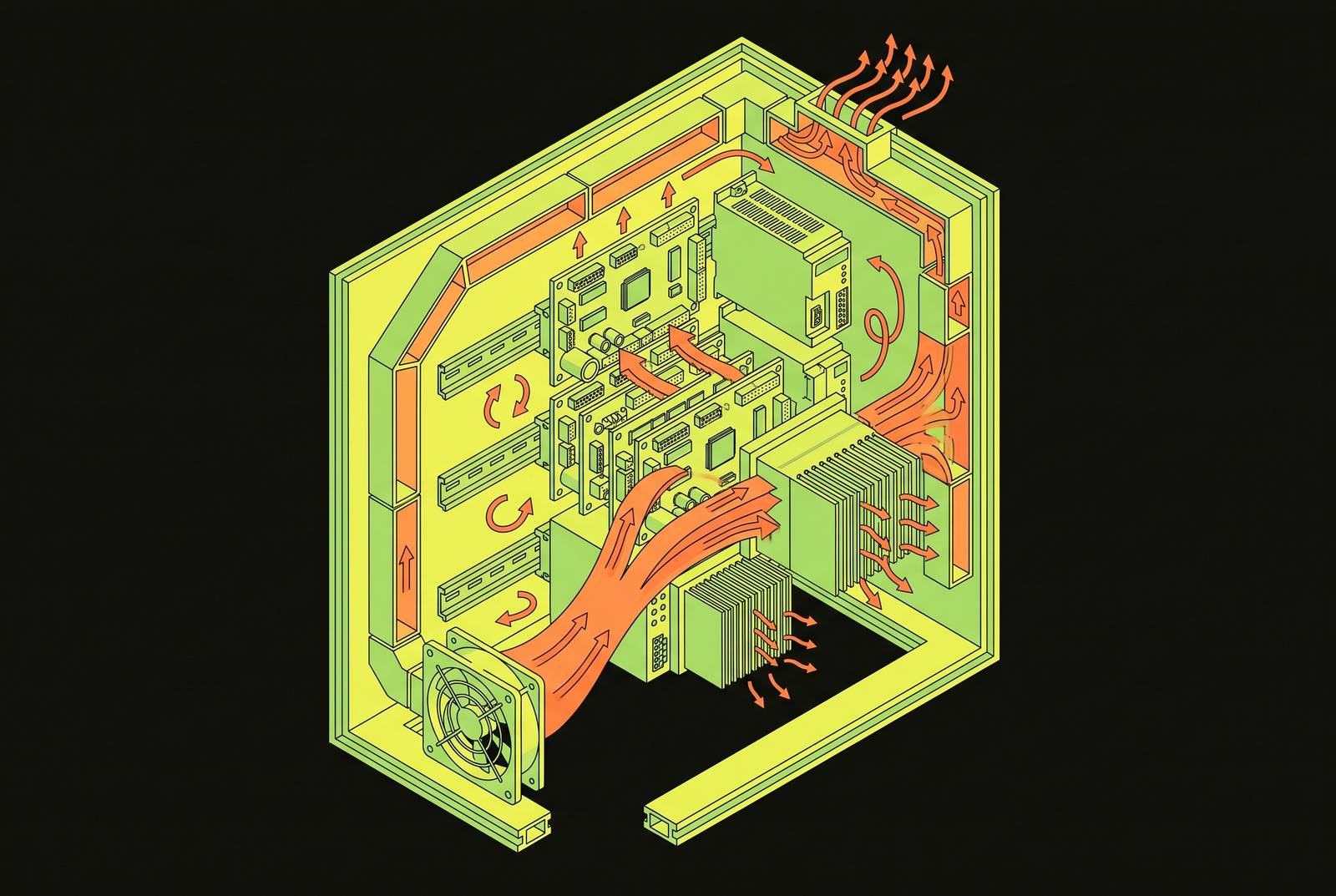
Seal a box tightly enough to keep dust, coolant mist, and moisture out, and the box also stops the air that would otherwise carry heat away. That's the condition every enclosed robot controller cabinet lives in, and it's a trade built into the design, not a flaw in it. Inside sits a controller running motion logic, I/O processing, and communication stacks, generating waste heat continuously while the enclosure around it does the job it was built to do: keep the outside world out. The conflict is structural. A higher IP rating buys better protection against contamination while making heat removal proportionally harder, so every design decision on the cabinet has to negotiate between the two demands. A well-built enclosure handles thermal management, cable routing, grounding continuity, and safety architecture together, and a meaningful share of unplanned robot downtime traces back to environmental exposure inside that enclosure.
Where the heat comes from inside the cabinet
Heat inside a robot controller cabinet comes from several distinct sources, each with its own size, location, and behavior under load, and treating them as a single lump makes the problem harder to solve. Power electronics, the motor drives and control circuits that move the robot, turn a meaningful fraction of their input power into waste heat, and they produce localized hot spots that can push past safe operating thresholds well before the rest of the cabinet feels warm. Servo and stepper motors add their own load during continuous operation, especially under heavy work, and the mechanical consequence matters as much as the electrical one: at elevated temperatures, thermal expansion in moving parts throws off positioning accuracy in ways that show up directly in manufacturing quality. Deceleration adds a third source that's easy to overlook. When a motor slows down, it returns energy that has to go somewhere, and regeneration resistors dissipate that energy as heat. The KUKA KR C2 design handles this by routing its ballast resistor to an outer zone of the cabinet, cooled directly by ambient air, separate from the more sensitive inner electronics. Processing and communication hardware contributes a steadier, less dramatic load, but that load is growing. As controllers take on more autonomous, AI-capable processing, the compute stack, the high-density electronics, and the communication hardware all add to the cabinet's thermal budget in ways earlier generations of controllers never had to handle. Autonomous mobile robot enclosures show how severe this can get: compute modules, motor drivers, sensors, and battery losses together can push total thermal loads into the hundreds of watts inside an enclosure with a fraction of a server chassis's volume, and none of a data center's airflow infrastructure to help. Miniaturization compounds the problem too, because newer components pack more heat into less space than the generation before them. None of this heat spreads evenly through the cabinet. It concentrates at specific points, near the drive electronics, near the resistor bank, near dense compute, and that concentration of hot spots, not a gentle rise in average temperature, is the real design challenge the rest of this piece addresses.
What happens when those heat sources go unmanaged
Unmanaged heat inside a cabinet doesn't produce one failure. It produces three, operating on three different clocks. The immediate pathway is thermal throttling and shutdown: when components cross their safe operating temperature, the controller protects itself by cutting performance or stopping outright, and a production line goes idle while an electrical system defends its own hardware. The medium-term pathway runs through mechanical precision. When servo motors run hot, thermal expansion changes the geometry of moving parts, and that can push positioning outside tolerance, so a robot can keep running while it quietly turns out parts that fail inspection. The long-term pathway is slower and more expensive to reverse: accelerated component degradation. Arrhenius equation modeling puts a number on this relationship, and the number is severe: every 10°C reduction in operating temperature roughly doubles component lifespan. Run a cabinet 10°C hotter than it needs to run, and its electronics age at twice the rate they should.
Fan failure shows how fast the acute pathway can arrive. KUKA's KRC2 throws error 315, "top fan malfunction," because losing airflow in a fan-cooled cabinet can cascade to overheating quickly enough that a single mechanical part failing, one small fan, stops an entire production line. Collaborative robots add one more constraint that caged industrial robots don't face: surface temperature has to stay safe for a person working next to the robot, even as the components inside keep generating heat, which narrows the thermal design options further for any cobot enclosure.
The four cooling strategies available to cabinet designers
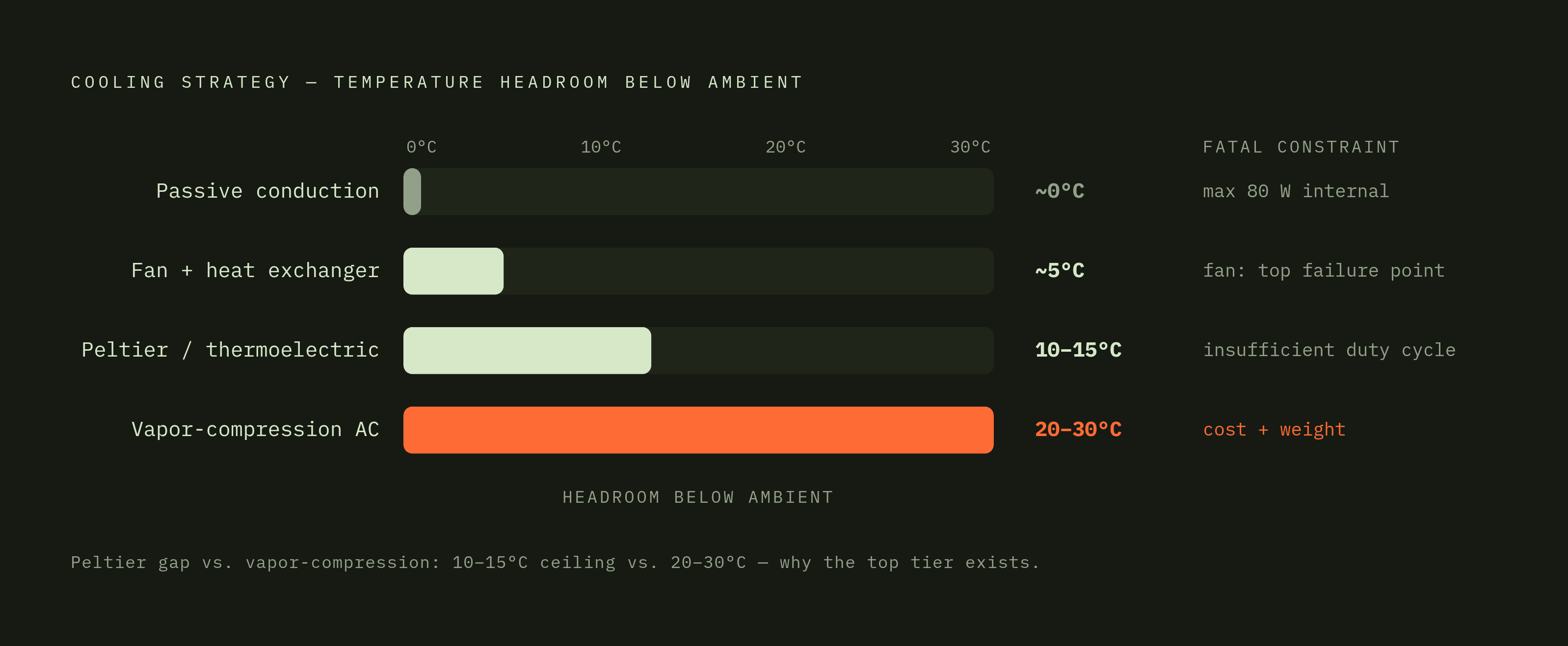
Every cooling strategy has to move heat out of a sealed box without letting the environment in, and every answer carries its own risk alongside its benefit. Four strategies cover the field, and they escalate roughly from passive to active as the heat load and ambient conditions demand more.
Passive cooling, built from conductive chassis panels, heat sinks, and thermal pads, moves heat from components to the enclosure wall with no moving parts and no failure modes of its own, which keeps the seal fully intact. It also has a hard ceiling: passive cooling can only bring the internal temperature down to ambient, so in a factory running at 40 to 45°C, the floor of what passive cooling can achieve is already near or above the safe limit for many electronic components. In practice, if a sealed enclosure generates more than roughly 50 to 80 watts of internal heat in a warm environment, passive cooling alone stops being enough.
Fan-forced air cooling with internal heat exchangers is the dominant approach in production today: cheap, serviceable, and well understood by the technicians who maintain it. The KUKA KR C2 runs a dual-circuit version of this idea, with inner electronics cooled by a heat exchanger and an outer zone, holding the ballast resistor and the heat sinks for the servo modules and KPS, cooled directly by ambient air. The KUKA Sunrise Cabinet uses two fans to cool control and power electronics, and it can run across an ambient range of +5 to +45°C. The vulnerability sits in the fan itself: it's the most common cooling solution and the single most common point of failure, which makes fan monitoring essential for catching a failing fan before it takes the cabinet down. Integrators sometimes add filter mats upstream of the fan to block particulates, but that choice can push the temperature inside the cabinet up too far. KUKA warns against installing upstream filter mats for exactly this reason: solving a contamination concern with one hand while creating an overheating problem with the other.
Thermoelectric, or Peltier, coolers look appealing for sealed enclosures because they use no refrigerant and carry few moving parts, which makes them an obvious option to consider between fan cooling and liquid systems. Their limitation is physical rather than practical: Peltier devices struggle to achieve more than 10 to 15°C below ambient at reasonable efficiency, which makes them insufficient for industrial duty cycles where the ambient temperature is already pushing the upper end of the range.
Air-to-liquid heat exchangers, running as closed-loop liquid cooling, introduce a different hazard: condensation. If the supply water runs cold enough, the exhaust air inside the cabinet can drop below the enclosure's dew point, and water droplets form directly on circuit boards, a short-circuit risk that air-only systems never have to manage. Energy efficiency standards in the IE4 and IE5 motor tiers favor liquid cooling structurally, because it can reach higher coefficient-of-performance values than air-based systems. But air-based systems stay the more common choice across most factory deployments, because condensation risk, leak risk, and maintenance complexity outweigh that efficiency edge.
Vapor-compression micro air conditioning sits at the most active end of the spectrum. A vapor-compression system can hold enclosure temperatures 20 to 30°C below ambient, unlike a Peltier device, so electronics stay at roughly 25°C even while the robot works in 45°C foundry or outdoor heat. Micro DC air conditioning units connect directly to a robot's DC bus, typically 12V, 24V, or 48V, and run on variable-speed BLDC compressors that scale cooling output to the actual load. These systems can maintain IP65 or IP67 integrity through sealed refrigerant line penetrations, so the seal and the cooling capacity don't have to compete. The technology is migrating from autonomous mobile robots toward stationary controller cabinets in hot-factory and foundry settings, but it costs more and weighs more than air-cooled designs do.
None of these four strategies is simply "better" than the others. Each one wins under a specific combination of heat load, ambient temperature, and contamination requirement, so you need to read those conditions before you compare cost or complexity.
Duty cycle, ambient conditions, and enclosure rating as determinants of cooling strategy viability
The operating environment and the required IP rating eliminate most cooling strategies before cost or complexity ever enters the conversation, so you don't just pick what you prefer. Three variables decide the outcome, and they need to be resolved in a specific order.
Ambient temperature comes first. The KUKA Sunrise Cabinet's documented operating range of +5 to +45°C illustrates the constraint directly: fan-air systems are bounded by the ambient temperature around them, so a factory floor that approaches or exceeds that ceiling pushes designers toward sub-ambient active cooling, whether that's vapor compression or a liquid-based system. Harsher environments make the constraint sharper still. Factories running above 85°C ambient, or outdoor applications swinging from -40°C to 60°C, create thermal stress that no passive or fan-only solution can absorb safely, regardless of how well-built the cabinet otherwise is.
Particulate and contamination level comes second. Welding cells, foundries, and facilities running coolant mist all demand high IP ratings, and climbing ratings make moving air through the enclosure progressively harder. That's why designers in those environments reach for closed-loop liquid or vapor-compression systems instead of fans. The integrator habit of bolting a filter mat onto a fan-cooled cabinet to manage particulates is a documented failure mode: adding the filter blocks the airflow the cabinet needs to shed heat, so it solves contamination at the cost of causing the overheating the cabinet was built to prevent.
Duty cycle and load profile come third. When operation runs continuously at high load, you get the worst-case internal temperature delta, and that's when fan-only cooling fails most often. If the delta climbs more than 15°C above ambient under full load, you face real thermal throttling risk. Intermittent or lighter-duty cycles give passive and fan systems recovery windows that continuous operation never gives them. Collaborative robot applications add a constraint on top of all three: safe surface temperature is a hard requirement independent of the internal thermal budget, and it can force a more aggressive cooling choice than the heat load by itself would call for.
Integrators have converged on a practical diagnostic that cuts through all of this: ask first what the internal temperature delta is at 40°C ambient under full load. That single number says more about which cooling strategy will actually hold up than the IP rating or the name of the cooling method ever will.
AI-driven control and predictive modeling for extending existing cooling hardware
Smarter control doesn't replace any of the four cooling strategies described above. It changes how hard each one has to work, trimming peak thermal loads and extending the range over which a simpler strategy stays viable. Shili and colleagues, writing in Electronics in 2025, propose a closed-loop framework that pairs adaptive control with lightweight machine learning, so it can estimate internal motor temperatures in real time and adjust operating parameters on the fly. Their experimental validation showed reduced peak temperatures and extended motor lifetime, and control stability held up across varying workloads, and that matters because a thermal control scheme can't sacrifice stability just to save a few degrees and still work on a production line.
A related 2025 approach trains a deep neural network on sensed joint torques, so it can predict how joint motors heat up across a redundant seven-joint manipulator, and you don't need a dedicated thermal sensor on every joint. The method is model-free and scalable. It generalizes across different manipulator configurations rather than requiring a bespoke thermal model built for each one. Predictive thermal management in compact embedded designs has already shown gains in sustained performance, with reduced fan usage and lower peak temperatures, by cutting worst-case thermal loading; if those gains hold at production scale, they give a longer working life from an air-cooled cabinet. Digital twin approaches push the idea further still, using machine-learning models that predict thermal state from standard API data rather than from a dedicated sensor on every joint, which lowers both hardware cost and the amount of equipment that needs maintaining over the life of the system.
None of this removes the need to choose correctly among the four cooling strategies described earlier. What it does is shift the crossover point, the load and ambient combination at which fan cooling no longer suffices and something more aggressive becomes necessary. Shifting that crossover point even modestly gives you a real operational and cost advantage, since a simpler, cheaper cooling architecture can then cover a wider range of conditions than it otherwise could.
What a well-designed thermal management approach looks like
A well-designed cabinet doesn't resolve the tension between sealing and cooling by picking a single best method. It resolves it by matching a cooling strategy to the actual environment the robot will run in, built from the heat sources catalogued earlier and tested against the failure modes those sources cause when left unmanaged. That starts when you honestly measure the ambient temperature ceiling and the contamination level, because those two variables rule most strategies out before duty cycle even enters the conversation. It continues with monitoring built into the system rather than bolted on afterward: fan health sensors that catch a KRC2-style failure before it becomes error 315 and a stopped production line, and thermal delta tracking that flags a cabinet running 15°C or more above ambient under full load before that margin turns into throttling or shutdown.
It also means treating predictive control and adaptive thermal modeling, the kind of work Shili and colleagues demonstrated in 2025, as a way to extend the working life of existing hardware, with choosing the right cooling architecture remaining the primary decision it supports. And it means accepting that higher IP ratings will keep making thermal engineering harder, not easier, as robots move into welding cells, foundries, and outdoor conditions that push ambient temperatures toward the edges of what any single cooling strategy can absorb. The cabinet that holds up over years of continuous operation is the one designed from the start around that tension, rather than the one that treats heat as an afterthought to be managed once it becomes a problem.