IP67 Sealing Strategies for Mobile Robot Chassis
Balancing seal type, material, and geometry matters more than hitting the IP67 label.
IP67 on a mobile robot chassis is a layered engineering problem, not a single spec you either meet or miss. Getting there means picking the right seal for each interface, knowing exactly where the standard stops testing, and treating seal integrity as something that has to hold up over years, not just on the one day a lab signs off.
Start with what the number actually means. Under IEC 60529, the first digit covers solid particle ingress and the second covers liquids. A 6 in the first position means the enclosure is fully dust-tight. A 7 in the second means it survives immersion to a depth of 1 meter for 30 minutes https://www.therobotreport.com/bal-seal-offers-pre-certified-ip67-ip69-seals-for-robots/ https://fictionlab.pl/blog/ip-ratings-explained-what-ip54-ip65-and-ip67-actually-mean-for-your-robot/. That's the whole test: submerge it, wait half an hour, pull it out, check that nothing got in.
Many people treat IP67 as if it covers water pressure generally, and it doesn't. IP67 says nothing about resistance to a directed water jet, which falls under the IPX5 and IPX6 tests instead. A robot that needs to survive both a puddle and a pressure washer needs a dual rating, something like IP65/IP67, because a single number can't speak to both immersion and jet impact at once.
The immersion test is also a type test. It certifies one unit, one time, under lab conditions, using fresh water at a specified temperature. Seal degradation across the robot's working life sits entirely outside the standard's scope, so the burden of long-term performance falls on the design team, not the certificate. A chassis rated IP67 in a lab has told you nothing about how its seals hold up against coolant mist drifting over from a CNC cell next door, or brine on a dockside AMR route. Those environments call for their own material choices, made separately from whatever number sits on the spec sheet.
When IP67 is the right target, and its limits
Matching an IP rating to an environment comes down to what the robot will actually touch, and how often. A robot confined to a dry indoor lab rarely needs more than IP4x. Move it outdoors onto sidewalks or a campus route, and IP54 becomes the floor rather than the ceiling. Anywhere with routine washdown, IP65 and above is the starting point. For brief immersion, outdoor transit between buildings, rain, and standing puddles, IP67 is the baseline. Sewer inspection robots, marine deployments, and flood-prone remote installations push past that into IP68 territory.
Most warehouse robots never come close to testing the limits of IP67, and overspeccing here wastes money without buying anything real. Floor-wash routines and an occasionally spilled tote of liquid are what these machines actually encounter, and IP67's benchmark of 1 meter for 30 minutes badly exceeds what a wet mop delivers. Specifying IP67 for that use case is matched to the actual failure mode the robot faces on the floor, not to some worst-case scenario dreamed up in a spec meeting.
Food processing is the case that catches people off guard, because the environment often exceeds what IP67 was ever built to test. Routine washdown cycles fall within IP67's coverage, and production robots like the FANUC M-20iD/25 and the ABB IRB 1200 ship in IP67 variants for exactly this kind of work. But food and pharma facilities frequently run directed, high-pressure, high-temperature spray-downs as part of daily sanitation, and that's a jet test, not an immersion test. Once the washdown protocol calls for directed high-pressure spray rather than a hose trickling into a floor drain, the spec needs to move to IP69 or a dual rating, because IP67 alone doesn't cover jet impact.
Water reaches a robot either as standing exposure or as a directed jet, and a seal built for static immersion can fail under a jet because the pressure profile is entirely different. Anyone speccing a robot for a washdown environment has to ask which of those two conditions actually applies, and guessing wrong here is the single most common way an otherwise well-built robot fails in the field.
The layered sealing architecture: why no single seal type covers the whole chassis
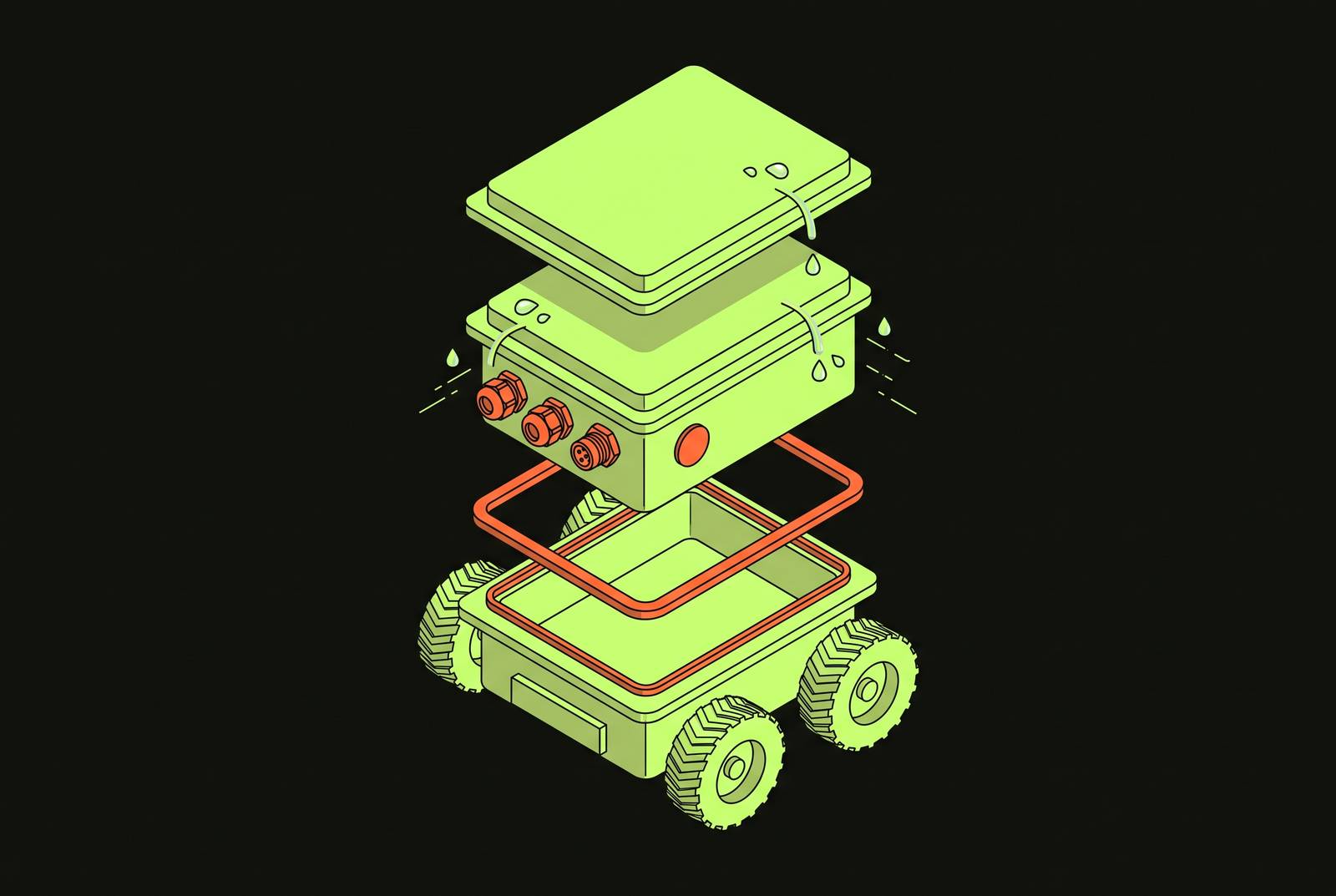
Sealing a mobile robot chassis works in tiers. The outer shell handles gross contamination first: dust, splash, the everyday grit of a warehouse floor. The genuinely sensitive components, the compute module, the battery pack, sit inside their own secondary sealed enclosures, with protection layered on top. Losing the outer barrier doesn't necessarily take down the whole robot if the inner tier holds. That redundancy is deliberate: a design with layered protection fails safe, while one without it fails all at once.
It has to be deliberate, because every interface on the chassis is a place where the rating can quietly fail. A cable gland, a bolt hole, a connector that wasn't actually rated for the application: each of these is a potential gap, and the assembly's real-world rating is only as good as its weakest point, whatever number appears on the spec sheet.
Different interfaces demand genuinely different sealing approaches, too. A static face seal behaves nothing like a rotating drivetrain seal, and neither behaves like the seal needed at a cable penetration or a PCB enclosure. No single gasket material or seal geometry solves all of these problems at once. Building an IP67 chassis means matching seal type to interface type, one at a time, then verifying that the assembled whole performs the way the individual parts suggest it should.
Gaskets and O-rings: geometry and compression as the primary variables
Most of the chassis seam work comes down to O-rings and gaskets, and getting them right starts with material selection. High-quality silicone gaskets are the standard at structural seams, and wherever a connector crosses the chassis boundary, it needs to be a variant actually rated for the job: an IP67 USB-C port sealed as part of its original design.
The performance of any O-ring comes down to two variables that matter more than the material spec itself. First is gland geometry, the groove or channel machined to hold the O-ring, which sets how much the ring compresses once installed. Second is the fit between O-ring size and that gland. Get the geometry wrong, too shallow a gland, too loose a fit, and the O-ring can be the correct material and still fail to seal, because sealing force comes from compression, not from the material simply sitting there.
Compression isn't a one-time event either. Elastomeric O-rings take what's called a compression set over time, a permanent deformation under sustained load that reduces how much sealing force the ring can still generate. A seal that passed certification on day one can lose meaningful sealing force after months of continuous compression. Replacement schedules matter as much as the initial spec.
Material selection at each seam should track the environment the robot actually operates in. Getting this wrong is a slower failure than a bad gland, but it's a failure all the same. Silicone earns its place through a wide temperature range. EPDM holds up better against outdoor UV and general weathering. Fluoroelastomers go in wherever chemical exposure, solvents, fuels, aggressive cleaning agents, is a real risk.
Spring-energized seals: where low friction and long cycle life matter more than simplicity
At joints, arms, and actuators, where a seal has to move rather than just sit still, elastomeric O-rings start to show their limits, and spring-energized seals take over. The construction pairs a spring, usually a canted coil spring, with a precision-machined jacket made from PTFE, PEEK, or a similar engineered polymer. The spring keeps sealing force consistent across millions of cycles, rather than relying on the jacket material alone to hold its shape.
Friction runs significantly lower and more consistent than with elastomeric O-rings, which matters for motion accuracy and motor load. The spring resists compression set the way a plain elastomer can't, so sealing force doesn't quietly degrade the way it does in a static gasket under sustained load. The polymer jacket itself tends to beat elastomers on chemical resistance, temperature range, and wear life, and that adds up over the working life of a joint cycling constantly rather than sitting compressed once.
These seals belong wherever a robot actually moves: joints and arms, end effectors, actuators and motors, anywhere the service is rotary or reciprocating rather than static. Bal Seal Engineering now supplies spring-energized seals pre-certified to IP67 and IP69 standards through an accredited third-party lab before the parts ever ship, with certification documentation included, for both standard and custom designs. That pre-certification matters less as a convenience and more as a shift in who carries the testing burden. A robot builder speccing one of these seals isn't running in-house immersion tests or outsourcing that verification, because someone already did it and documented it before the part arrived.
Cable penetrations: the gap between a rated connector and a sealed assembly
IEC 60529 tests a connector on its own, a gland on its own, and a housing on its own. It does not test complete cable assemblies. That distinction sounds minor until it's the reason a robot fails in the field despite every individual part carrying a passing certificate. Treat every certified connector as untested until the whole cable-to-connector stack has been checked together, because that's the only test that actually matters.
A connector rated IP67 mated to a cable with an unsealed backshell delivers IP67 protection at the mating face and zero protection at the cable entry, so the assembly fails even though every part passed.
This isn't a theoretical gap. One AMR fleet operator specified IP67-rated M12 connectors for a warehouse floor deployment, and eight months in, coolant mist drifting over from an adjacent CNC cell had corroded every backshell junction where the cable jacket met the connector body https://roboticscableassembly.com/blog/robot-cable-assembly-ip-rating-guide. The connectors themselves had passed lab testing without issue. The assemblies hadn't, because the complete cable-to-connector seal was never actually put through that test in the first place.
The fix isn't complicated, but it does demand a change in what gets specified and verified. IP ratings need checking at the assembly level, the whole cable-connector-backshell stack together, with the component level checked as part of that same review. Cable glands need correct specification and correct installation: thread engagement, O-ring condition, and a proper match between gland size and cable diameter all decide whether the seal actually holds. Backshell sealing needs to be treated as a designed interface from the start, not something patched in the field with whatever sealant happens to be on hand.
Pressure-equalization venting: managing the thermal breathing problem without breaking the seal
Sealing a chassis completely creates a new problem. As internal temperature swings, so does internal pressure, and an enclosure with nowhere for that pressure to go will eventually push a seal open from the inside, or pull moisture in through it as the chassis cools and internal pressure drops below ambient.
The fix is a pressure-equalization vent: a small opening covered with an ePTFE membrane that lets air and water vapor pass through freely while still blocking liquid water and dust on the outside. The enclosure breathes, pressure equalizes on both sides of the membrane, and the liquid barrier stays intact the whole time. ePTFE membranes suit outdoor mobile robots because they're chemically inert, UV-resistant, and effective across a wide temperature range.
Thermal management inside a sealed chassis: the tradeoff that constrains every other design choice
Every high-IP design runs into the same tension eventually. Fans move air, and moving air pulls dust and moisture into an enclosure, so high-IP designs drop fans almost by default. That leaves the heat from compute and motor controllers with nowhere to go, unless the thermal path gets designed in from the start.
The heat load is real, and not small. Compute modules, NVIDIA Jetson boards, industrial PCs running perception and navigation stacks, generate somewhere between 15 and 75 watts continuously in a medium-sized autonomous robot https://rigidchill.com/robot-cooling-system-dc-autonomous-enclosure/. All of that has to go somewhere, and in a sealed chassis, it can't leave through an airstream.
Passive cooling is the common answer: heat conducts through the chassis walls themselves, aluminum or stainless steel, and dissipates off the external surface, turning the whole enclosure into a heatsink. Done properly, this keeps typical IP67 computers running reliably across a temperature range from -30°C to +70°C with no drop in performance https://psb-engineering.de/en/outdoor-pc-ip67-guide/.
Active cooling is heavier and more complex, and it only earns its place where the heat load actually demands it. For high-heat payloads, sealed micro DC air conditioning is the active alternative, and its refrigeration cycle needs only refrigerant lines and a condensate drain to penetrate the enclosure wall, each sealable to hold an IP65/IP67 rating. Reach for it before the heat budget forces the issue, and the design carries weight and complexity it doesn't need yet.
PCB-level protection: conformal coating and potting as the last line of defense
Even with a sealed chassis, individual boards inside often get their own layer of protection, and there are two established ways to do it.
Conformal coating applies a thin protective layer, somewhere between 25 and 250 micrometers, directly onto the board surface https://www.pcbway.com/blog/PCB_Basic_Information/PCB_Protection_Potting_or_Conformal_Coating_PCB_Knowledge_fee92383.html. It keeps the board flexible, allows visual inspection afterward, and doesn't stand in the way of rework if a component needs replacing later. Materials range across acrylics, silicones, urethanes, and epoxies, each with its own tradeoffs in chemical resistance and ease of application.
Potting gives up all of that flexibility in exchange for a harder barrier. Repair on a potted board is difficult at best and often impossible, since reaching the component means cutting through the resin protecting it. Getting full waterproofing out of conformal coating alone usually takes more than one pass: multiple layers, or a UV-cure coating system, plus underfilling with epoxy for the most vulnerable parts, BGA chips especially, where moisture penetrates under the solder balls and a surface coating can't reach it.
Whether the board will ever need field service is what should decide between the two methods. If that decision is treated as an afterthought, designs end up either scrapping boards that could've been repaired, or fielding coated boards that fail the first time real moisture gets to them. Conformal coating makes sense wherever in-field repair or inspection is part of the maintenance plan. Potting makes sense wherever the operating environment is severe enough to demand it and repairability isn't a real requirement. Plenty of designs mix both: potting for the modules hardest to replace or most exposed to the environment, coating for the boards more likely to need servicing down the line.
Sensor and drivetrain interfaces: where sealing conflicts with function
A mobile robot chassis isn't a closed box. Wheels turn, LiDAR units spin or scan, motor shafts rotate, and charging contacts have to physically touch something external, so each of these is a point where the robot has to interact with its environment while still keeping that environment out of the internals.
At the drivetrain, protected motor assemblies stop wheel splash and mud from working into bearings or motor windings, and the shaft seal at each wheel hub is the critical point in that design, one of the places where spring-energized seals or conventional lip seals earn their keep given how much cycling that interface sees.
LiDAR and camera housings are, on their own, a solved problem: waterproof enclosures for these sensors exist and work. The harder difficulty sits outside the housing, not inside it. Water droplets on a lens or a sensor window scatter LiDAR returns and confuse camera-based perception, degrading the very function the sensor exists to provide, even with a housing sealed perfectly well underneath. Outdoor robots deal with this through rain-filtering algorithms in software, physical wipers, or air-blast systems that clear the surface mechanically, and each of those fixes brings its own moving parts and its own new point to seal. The Livox Mid-360S is one example of IP67 LiDAR hardware already on the market.
Charging contacts sit at maybe the sharpest version of this conflict anywhere on the robot. The interface has to make clean electrical contact in wet conditions, resist corrosion across a design life industry sources put at 10,000 or more insertion cycles, and avoid arcing in a DC system, all at once, in a spot exposed to weather by definition https://www.phihong.com/ip67-robot-charging-station-how-to-build-waterproof-docks-for-outdoor-delivery-bots/. Electrical reliability and IP compliance pull against each other here more directly than almost anywhere else on the chassis. Pogo pin contacts paired with hydrophobic seals are the common answer, a way to satisfy both demands without giving up too much on either side. Potting at these interfaces typically runs 1 to 10 millimeters thick https://www.pcbway.com/blog/PCB_Basic_Information/PCB_Protection_Potting_or_Conformal_Coating_PCB_Knowledge_fee92383.html.
None of it comes cheap. A high IP rating, IP65 or above, adds 15 to 30 percent to robot cost compared to an IP20 or IP54 baseline, once precision seals, waterproof connectors, and fanless cooling all get priced in https://www.chipsilicon.com/technology/ip_ratings_and_waterproofing_in_robots. Treating IP67 as a checkbox instead of an engineering commitment means that money gets spent without buying the reliability it's supposed to pay for. The number on the spec sheet only means something if the tradeoff it carries, upfront cost against years of field reliability, actually got made on purpose.