Solid-State LiDAR Comparison for Mobile Robot Navigation
Five specs, not brands, determine which solid-state LiDAR fits your robot's job.
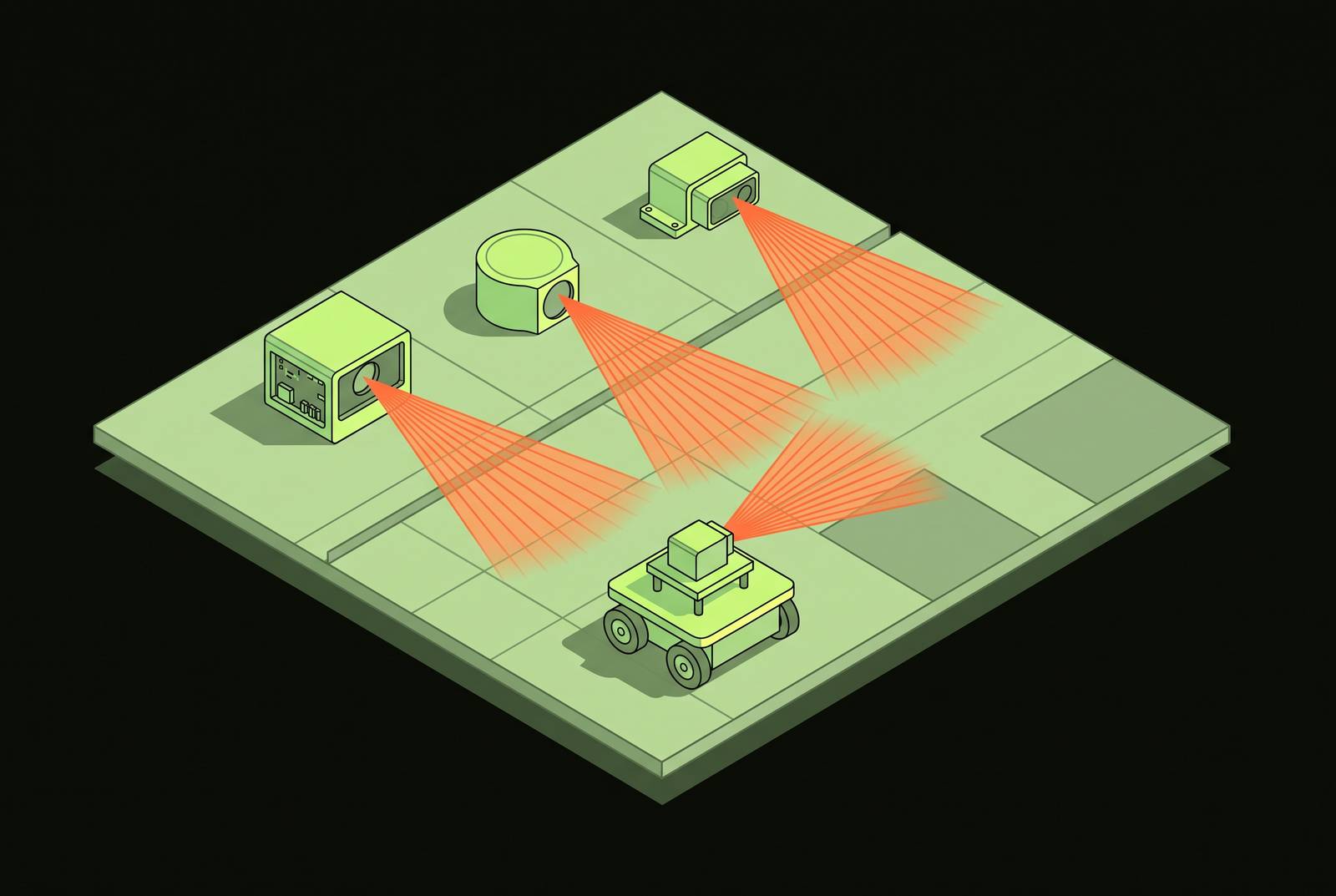
Solid-state LiDAR runs the perception stack on most new mobile robot platforms, and the choice among available units comes down to five measurable specs, not brand reputation. Scan pattern, range, field of view, update rate, and form factor decide whether a sensor fits a warehouse aisle, a campus sidewalk, or a hospital hallway. Get the match wrong and the robot either misses obstacles it needed to see, or it drowns its compute budget in points it never needed. Most teams still pick the sensor first and figure out the environment second. That order is backward, and it's why so many pilots stall out after the demo.
Solid-state LiDAR as the default choice for mobile robot navigation
A mobile robot has one real job that all the marketing language obscures: figure out where it is, where the walls and people and pallets are, and how to move without hitting any of them, while all of that keeps shifting in real time. Warehouses move inventory hour to hour. Hospitals fill hallways with carts and gurneys at random. A robot's map is a guess that needs constant correction, and that correction depends on depth data good enough to act on without a second thought.
Cameras and ultrasonic sensors both fall short here, and not in the same way. Cameras struggle when a loading dock goes from fluorescent light to open sunlight in the space of ten feet, and depth-from-vision math still carries more error than a direct range measurement ever will. Ultrasonic sensors give coarse distance and no shape. LiDAR measures depth directly, in millimeters, and it does not care whether the room sits pitch dark or lit like a stadium. That's why it became the anchor sensor for navigation stacks rather than a backup to them.
Spinning mechanical LiDAR did this job for over a decade, and it still shows up in some deployments today, but the moving part is exactly the weak point in a robot that runs eight, twelve, sixteen hours a day. A motor spinning a mirror or a full sensor head wears its bearings down. It picks up vibration from uneven warehouse floors and factory equipment. It needs maintenance schedules that a fleet of a hundred delivery robots cannot realistically support. Solid-state designs took the moving parts out, or shrank them down to a microscopic scale, and that shift tracks two industries that had every reason to solve it: automotive ADAS needed sensors that could survive a car's service life without a bearing replacement, and industrial automation needed sensors that shrug off dust, heat, and years of vibration cycling. Semiconductor manufacturing made the volume economics work. What came out the other side costs less, breaks less, and fits into a housing the size of a fist.
The three solid-state architectures and their tradeoffs
"Solid-state" covers three distinct ways of building a scanning path, and they do not substitute for each other cleanly. Anyone shopping by that one label alone, without asking which of the three they're actually getting, is going to end up with a sensor that fails at the one job it was bought to do.
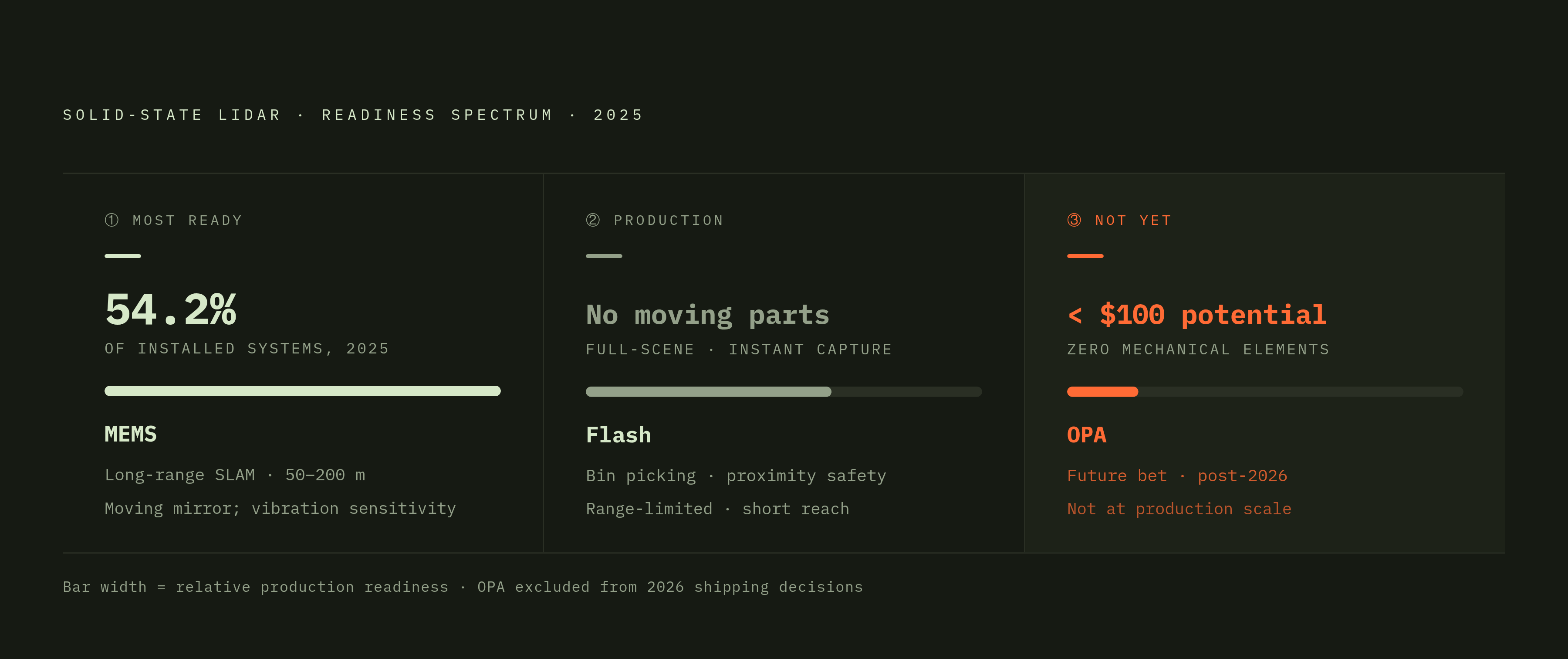
MEMS designs steer the laser with a microscopic oscillating mirror. It's still a mechanical element, just scaled down small enough that its failure modes look nothing like a spinning mechanical unit's. MEMS gives the best resolution for the cost available today, the supply chain behind it is mature, and it's the standard pick for long-range SLAM navigation, the kind an outdoor AGV needs to see 50 to 200 meters out. Business Research Insights put MEMS-based architectures at 54.2% of installed solid-state LiDAR systems globally in 2025, which makes it the default rather than a niche option. Engineering teams run into the real tradeoff after the spec sheet, not on it: they still need to characterize how that mirror responds to shock, confirm resonance margins once the sensor is bolted into its actual mount, and watch for drift from temperature swings, adhesive creep, or stress in the housing over time. MEMS scanning has already proven itself in production. It's not a lab demo waiting to happen.
Flash LiDAR skips scanning. One wide laser pulse lights up the whole field of view at once, and a focal-plane array detector catches the return in a single shot, with no moving parts of any kind. That gives instant full-scene capture, which matters more for bin picking, conveyor scanning, and close-proximity safety monitoring than it does for range. The cost: the laser's energy spreads across the whole field of view instead of concentrating on one line, which caps how far the sensor can see clearly, and pixel-level noise gets harder to filter out as range increases. Flash units already ship for short-range 3D obstacle detection on autonomous mobile robots. Nobody should expect one to handle a hundred-meter corridor, and anyone who buys one for that job has bought the wrong sensor.
Optical phased arrays steer a beam electronically, through phase differences across an array of emitters, with zero mechanical elements anywhere in the chain. That's the cleanest engineering story of the three: millimeter-level accuracy, real miniaturization headroom, and a fabrication path that could eventually push unit costs under $100. It's also the least ready of the three, and teams betting a 2026 launch on it are betting on a technology that hasn't shipped at scale. Widening the field of view on an OPA cuts aperture efficiency and reduces detection range, vertical FoV remains constrained, point cloud density still lags the other two architectures, and production costs remain high. OPA works fine in a demo. It has not proven itself on a production line yet.
That breakdown sets the frame for everything that follows. MEMS earns its keep on long-range SLAM, flash earns its keep on short-range instant capture, and OPA is a bet on where the field goes next, not a safe pick for something shipping this year.
The five parameters that determine sensor fit
Scan pattern and point density decide where a sensor's blind spots sit and how dense its point cloud gets on the object that actually matters. A forward-only sensor cannot see a cart rolling in from the side, full stop, and no amount of point rate fixes that without a second sensor covering the gap. Point-per-second numbers on a spec sheet only mean something next to the field of view they cover: the same rate spread across a hemisphere lands far sparser per square degree than the same rate aimed at a narrow forward cone.
Detection range depends entirely on where the robot works. A warehouse aisle calls for 10 to 30 meters. An outdoor campus delivery robot needs 50 to 200 meters to react to traffic and pedestrians at speed. A bin-picking arm needs accuracy at short range and nothing more. Range numbers on a datasheet get measured at a stated reflectivity, and stacking a sensor rated at one condition against a sensor rated at another produces a comparison that flatters one and misrepresents the other. Match the reflectivity condition first, or the comparison is worthless.
Field of view splits into horizontal and vertical, and each does a different job. Horizontal FoV sets how much area the sensor covers without needing the whole unit to turn. Vertical FoV decides whether the sensor catches floor-level clutter, overhead structure, or both. A low-mounted robot, a scrubber-dryer or a ground-hugging AMR, needs upward-looking vertical coverage to catch table legs and chair rungs before it clips them, and that spec swings by a wide margin from one product to the next.
Update rate sets how fast the robot can react. Faster robots and faster-moving obstacles need faster frame rates to keep a safe reaction window, and SLAM algorithms carry their own minimum update-rate assumptions baked into how they filter and align frames. Miss that minimum and localization starts to drift, subtly at first, then in ways that become visible as a robot clipping corners it used to clear cleanly. Software-defined sensors that let integration teams adjust scanning parameters rather than live with fixed hardware constraints hand engineers flexibility instead of a fixed constraint to design around.
Sensor-by-sensor comparison: RoboSense, Hesai, Seyond, and Livox across navigation use cases
RoboSense's E1R is a fully solid-state flash unit, no moving parts anywhere, and RoboSense describes it as the first fully solid-state digital LiDAR built for robots. It covers 120 by 90 degrees across 144 lines, at roughly 200,000 points per second, and it carries an automotive-grade environmental rating: -40°C to 85°C operating range, 50G vibration tolerance. Its flat form factor helps on compact robots where mounting depth is tight and forward coverage is the whole job. That 120-by-90 field of view is wide, but it isn't hemispherical, so a robot that needs full-perimeter awareness still needs a second sensor to cover its blind side. Anyone specifying the E1R alone for a robot that has to watch its own back is going to find that out the hard way, usually after a collision report.
RoboSense's Airy takes the opposite shape: a hemispherical digital LiDAR, 192 beams, 860,000 points per second, packed into a 60mm by 63mm housing under 240 grams, priced around $800 to $1,200 depending on volume. The hemispherical field of view sees above and behind the unit from a single sensor, which removes the need to stack multiple units just to cover the upper half of the robot's surroundings. Pudu Robotics uses the Airy in its scrubber-dryer robots, where that hemispherical view catches table legs and chair rungs from a mounting position low enough that a forward-only sensor would miss them, a concrete example of how sensor shape drives deployment fit. RoboSense shipped 185,500 robot LiDAR units in the first quarter of 2026, and the Airy is among the units driving that robotics segment. For service robots working at floor level in hospitality, healthcare, or retail, where clutter sits at every height, this is the shape that fits. A flat forward-facing sensor is the wrong call here no matter how good its range numbers look on paper.
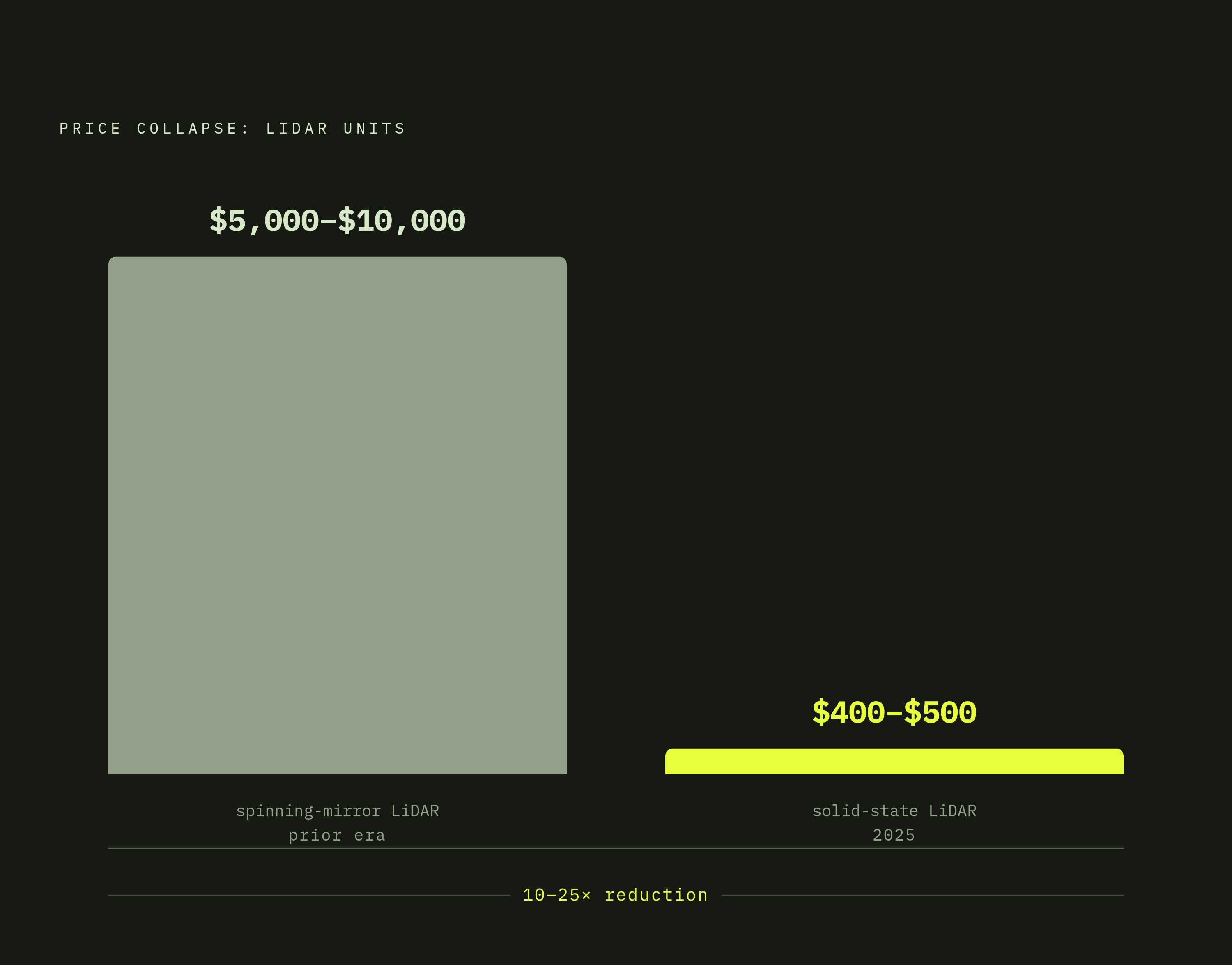
Hesai's JT series takes a different design path: solid-state, small, low power draw, wide field of view, with over 200,000 units delivered cumulatively. It shows up in DREAME's lawnmowing and robot vacuum lines, in the Vbot companion robot, in Realsee's 3D spatial digitalization work, and Meituan's Keeta Drone delivery unit runs on Hesai's FTX lidar rather than the JT series. What sets the JT series apart is software: scanning pattern and resolution adjust in software rather than hardware, and some perception functions run directly on the sensor's own silicon, which cuts the processing load an integration team has to budget elsewhere. Hesai passed 2 million cumulative LiDAR deliveries across its full product line in 2025 and is expanding annual production capacity past 4 million units in 2026. The company also points out that solid-state LiDAR now sells for $400 to $500, down from the $5,000 to $10,000 range that earlier spinning-mirror units commanded. That price collapse has done more to open up robotics adoption than any single spec improvement on any datasheet, and it's the real reason solid-state has displaced spinning LiDAR this fast.
Seyond's Hummingbird D1-R is fully solid-state and fully electronic in its scanning, no mechanical components anywhere in the path, covering an ultra-wide 140 by 100 degrees. It's mass-production ready and debuted at CES 2026, riding on the same platform as the automotive-variant Hummingbird D1, which secured a world-first OEM design win for passenger vehicles. The D1-R is the robotics-facing version of that same architecture, and it supports a satellite setup where raw data streams out to centralized compute, which suits robot platforms built around one central processor rather than per-sensor processing. Seyond's broader portfolio includes sensor configurations built on domestic production lines aimed at meeting BABA compliance requirements, though that hasn't been confirmed specifically for the D1-R configuration, and it matters for any team buying under domestic government or regulated procurement rules. Within Seyond's lineup, the D1-R is the short-range option, alongside Robin W for mid-range, Robin E1X for long-range, and Falcon K for ultra-long-range, which lets an integrator source a full range spread from one supplier instead of stitching together sensors from three vendors.
How navigation environment should drive the selection decision
Start with the environment. An indoor warehouse AMR running fixed routes needs reliable obstacle detection against a known map, a fast update rate to handle stop-and-go aisle traffic, modest range since most aisles run under 30 meters, and a compact housing that doesn't widen the robot's footprint. MEMS or flash solid-state sensors with wide-angle or 360-degree coverage fit that job well, and something in the weight and size class of the Airy keeps the robot's profile narrow while still covering the hemisphere above it, which matters wherever pallet racking overhangs the aisle.
An outdoor last-mile delivery robot or campus AMR needs a longer detection range, 50 meters or more, plus tolerance for direct sunlight, rain, and swings in temperature, and a vibration rating that survives cracked sidewalks and curb cuts. MEMS sensors with automotive-grade environmental ratings are the natural fit here, rather than flash units optimized for short-range indoor use. The E1R's -40°C to 85°C range and 50G vibration spec address the environmental durability side of this scenario, but the range ceilings this scenario demands push the real design decision toward scanning architectures built specifically for distance. Seyond's Robin W has already shown up in an autonomous logistics delivery vehicle, which gives this scenario a concrete point of reference beyond the spec sheet.
A service robot working in tight, cluttered indoor space, hospitality floors, hospital corridors, needs upward-looking vertical field of view above almost everything else, since the hazards are at table height and below: chair legs, feet, low carts. Hemispherical sensors solve this directly, and a flat sensor simply cannot, no matter how wide its horizontal spread runs. Pudu's deployment of the Airy in scrubber-dryer robots is the clearest real-world case of that fit working as intended.
A close-range application, tight bin picking, conveyor-side inspection, proximity safety curtains around a robotic arm, cares less about range and more about instant full-frame capture, and that's exactly the job flash architecture was built for. Range stops mattering past a few meters in this setting, so the tradeoff that limits flash units elsewhere barely applies here, and the no-moving-parts design keeps maintenance out of a workflow that already runs on tight tolerances.
The pattern across all four scenarios holds regardless of which vendor a team picks. The environment sets the requirement first, and the sensor gets chosen to match it, never the other way around. Picking the sensor before pinning down the environment means the spec sheet will always look fine right up until the robot clips something it should have seen.
Sources
- Seyond to Showcase Complete End-to-End LiDAR Portfolio and Mass-Production-Ready Solid-State LiDAR at CES 2026 | RoboticsTomorrow
- Solid-State LiDAR Guide | MEMS, Flash, OPA & Wavelengths
- sensorlidar.com
- openelab.io
- AGV LiDAR Comparison Matrix 2026: 12 Sensors Tested
- openelab.io
- prnewswire.com
- hesaitech.com