Intel RealSense D435 vs Stereolabs ZED 2 for Robot Depth Sensing
The D435 wins close-range grasping; the ZED 2 wins distance and sunlight.
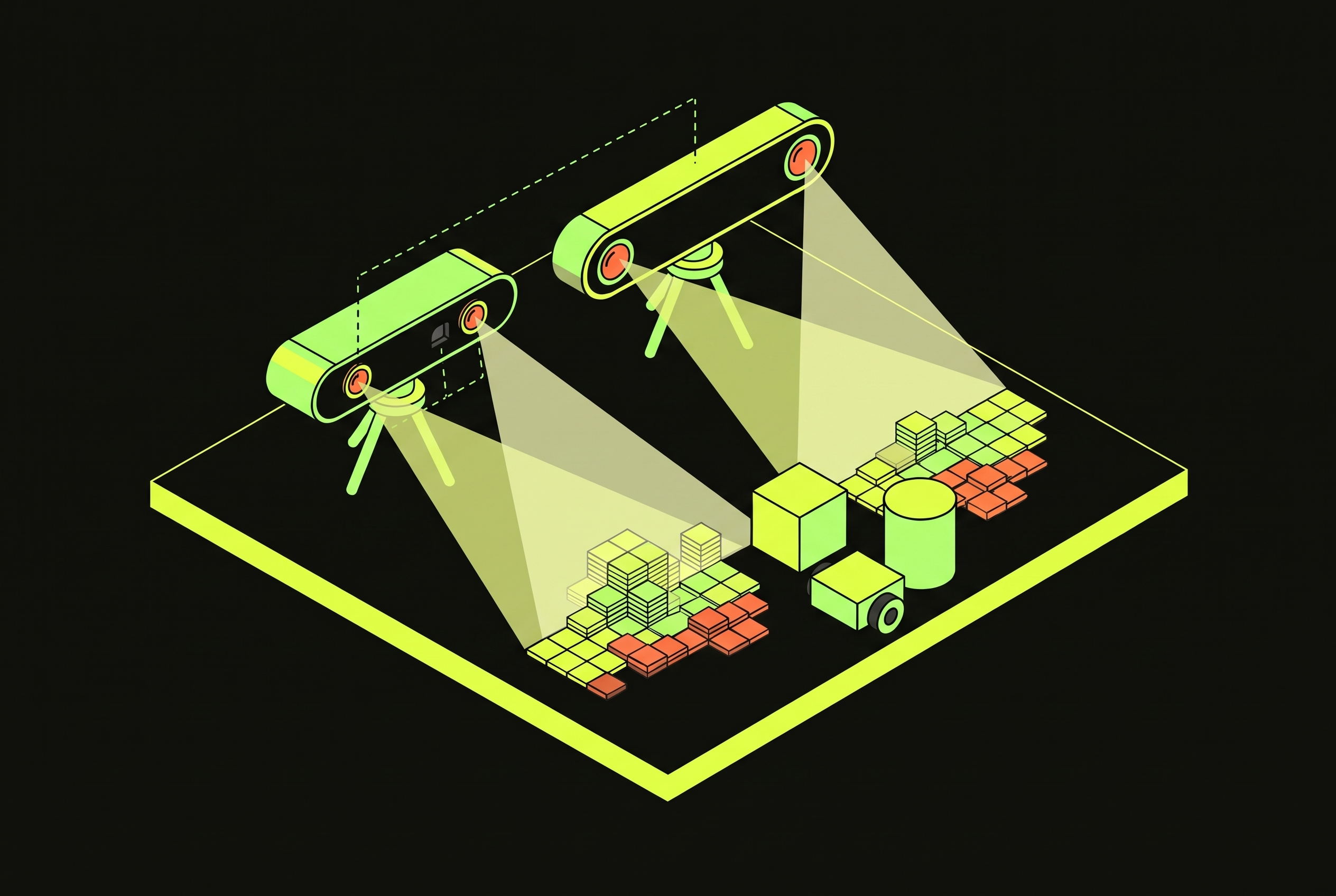
The Intel RealSense D435 and Stereolabs ZED 2 represent different approaches to robot depth sensing. The D435 combines active IR stereo with on-board depth processing, while the ZED 2 combines passive stereo with GPU-dependent processing. That architectural split is the most reliable guide to their suitability for a robot’s working distance, lighting, compute platform, and mounting constraints.
Why the D435 and ZED 2 produce depth in fundamentally different ways
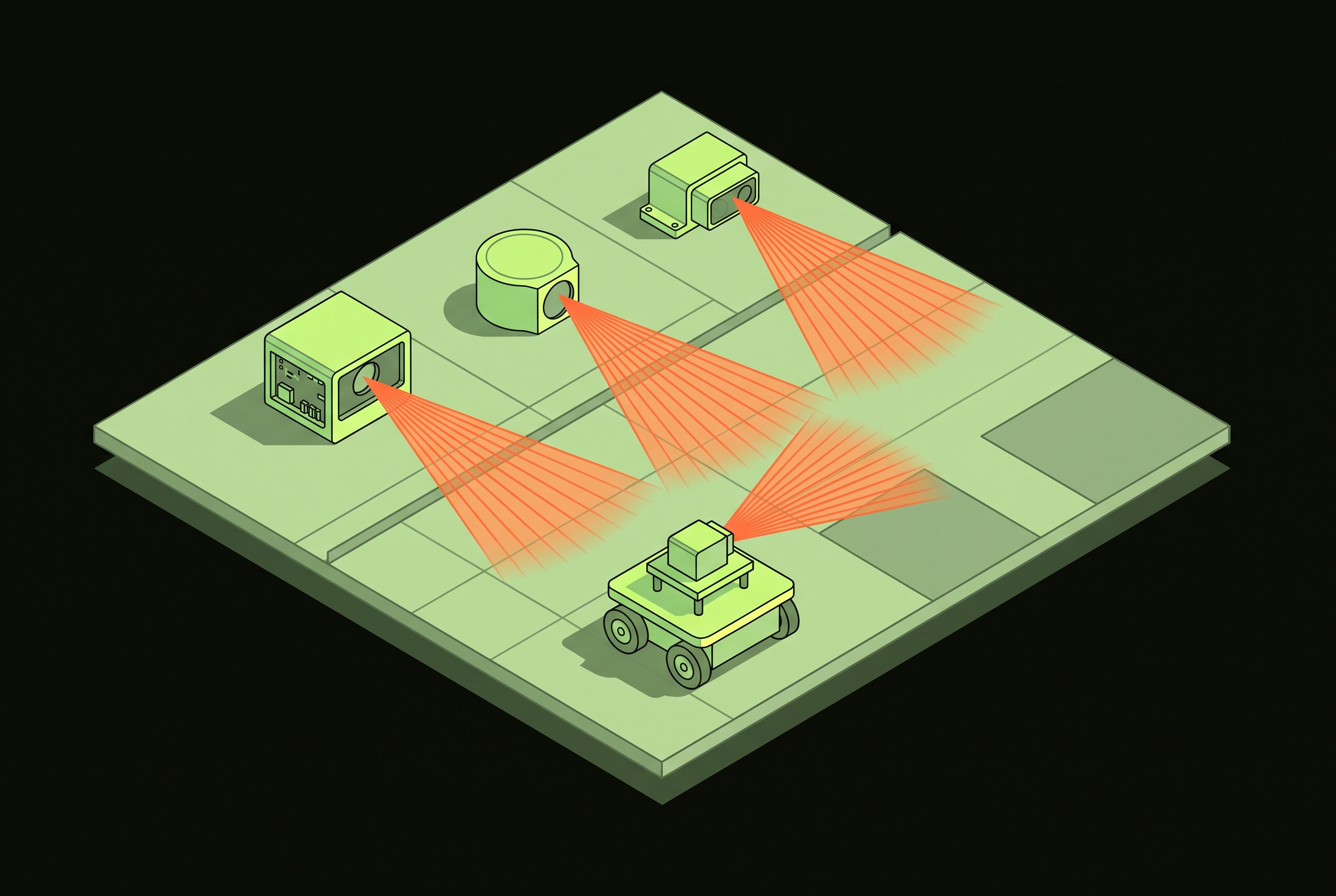
The D435 uses an IR projector to cast a dot pattern onto the scene. Two infrared cameras observe that pattern from different viewpoints, and disparities between their images provide the basis for triangulating depth. The projector supplies texture where the scene lacks it. The camera’s own processor computes depth, so the host receives a depth stream.
The ZED 2 instead uses two RGB cameras without IR projection. Its passive stereo architecture depends on naturally occurring texture to match features between views, with depth processing performed on the host GPU through the ZED SDK. The distinction begins with what the cameras can match. It then extends to where those matches become depth estimates. Naming also requires care because the literature sometimes uses “ZED 2” for the original camera and sometimes for the ZED 2i, the current production variant. The distinction is retained here where the evidence identifies a particular model.
What the architectural split means for compute dependency and system cost
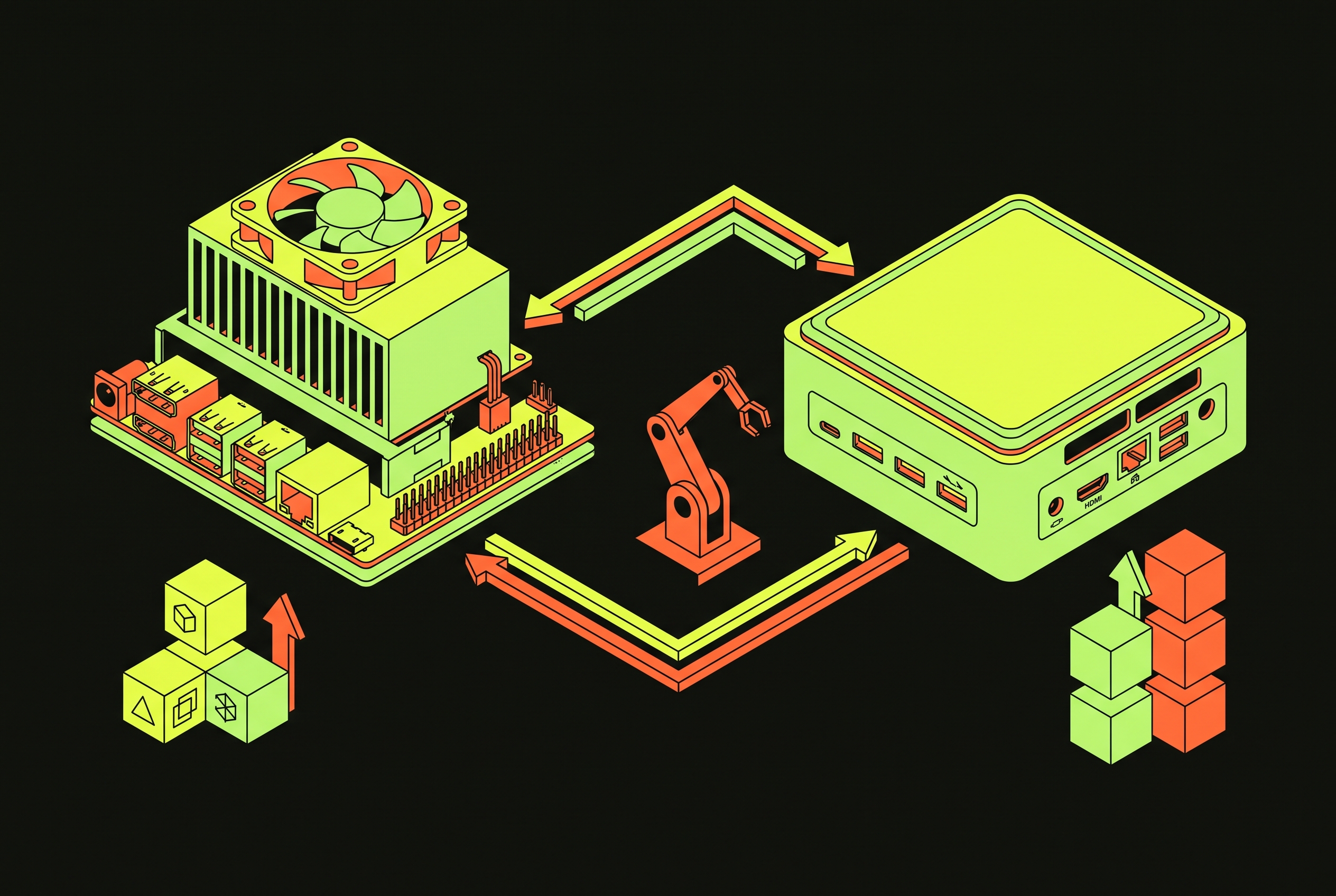
On-board processing gives the D435 broad host compatibility. It outputs depth over USB to ARM boards, embedded computers, and laptops without requiring the host to perform stereo depth computation. The ZED 2 places that work elsewhere. Its SDK offloads depth processing to a compatible NVIDIA GPU, making suitable host compute a condition of use. A lightweight ARM board without that GPU capability cannot use the ZED 2 for depth.
The ZED 2i is priced below the D435i as a camera unit, but complete system costs also include the required compute. Adding a suitable GPU to a robot that lacks one can cost far more than choosing the cheaper camera saves. Cost-sensitive and weight-constrained mobile platforms therefore face a compute decision before they reach the accuracy comparison.
For a robot already equipped with suitable NVIDIA hardware, such as an embedded computing platform, the calculation changes. That platform does not need an additional GPU purchase simply to support the ZED camera. Existing compute changes the cost comparison substantially. But a design built around a smaller host must allow for the platform change needed to handle host-side depth processing. Neither camera’s unit price settles that decision, because the two products place different amounts of processing responsibility on the robot.
How each architecture performs at close range, where robot manipulation actually happens
Rustler et al.’s 2025 IEEE Access paper, Empirical Comparison of Four Stereoscopic Depth Sensing Cameras for Robotics Applications, tested four cameras with more than 3,000 RGB-D frames per camera. The scenarios covered planar surface perception, plastic doll perception, and household object perception using the YCB dataset. At distances up to one meter, the D435 provided the best table-top performance, with error under 1 cm in every tested scenario. The result extended across the study’s three types of perception task.
That finding places the D435’s strongest evidence in the distance band where robot arms commonly grasp objects. Its projected texture helps it match low-contrast surfaces that have few natural features. Uniform objects present exactly that kind of difficulty. Without a projector, the ZED 2 must find correspondence in the visual detail already on the surface, so textureless targets can make passive matching less reliable. The study’s close-range result therefore fits the architectural distinction, although the reported error applies only to the tested scenarios.
Where passive stereo pulls ahead — accuracy beyond one meter and outdoor operation
The same study found that the balance changed beyond one meter. The ZED 2 was the best camera overall in the evaluation, keeping error under 3 cm even at 4 meters. The D435 and D455 began losing accuracy and precision beyond one meter, with distance overestimation and greater variability. Working distance changes which evidence is most relevant. The ZED 2’s overall result establishes a stronger case for longer-range sensing, alongside the D435’s advantage in the shorter table-top band.
Stereolabs specifies a ZED 2 depth range of 0.3 m to 20 m. That span is much longer than the D435’s ideal operating range, so passive stereo covers a wider range of distances for mobile robotics. Range and measured accuracy remain different claims. The manufacturer’s range specification states how far the camera can reach, while the study measures error at the distances tested. A maximum range alone gives no promise of equal precision across that range.
Strong sunlight can wash out the D435’s projected IR pattern and cause noisy or missing depth because the projector has to work against a high level of ambient IR radiation. Passive stereo avoids that particular failure mechanism. The ZED 2 uses visible-spectrum images and natural scene texture, which sunlight can make clearer. For outdoor ground vehicles, delivery platforms, and agricultural robots, the ZED 2i is consequently the architecture-appropriate choice of these two, provided the host meets its compute requirements.
The low-light and low-texture problem that passive stereo cannot IR-project its way out of
The outdoor advantage reverses when an indoor scene provides little light or texture. The study cites earlier work that found the ZED 2 performed less well in low lighting, which fits with a passive camera’s lack of IR projection. In darkness, passive matching loses the visual information it needs. The D435 can project texture from which it can compute depth in complete darkness and on blank white walls or matte uniform surfaces.
Warehouses and industrial sites often have smooth concrete floors, uniform shelving, and low or artificial lighting. Those conditions favor active IR stereo when natural image features are insufficient for reliable correspondence. A GPU does not remove that optical dependency. For indoor manipulation, the D435’s projector can be the enabling component that makes a surface measurable. The relevant contrast is not simply indoors versus outdoors, but whether the deployment supplies the light and texture each architecture requires.
Physical constraints: how form factor and sensor suite affect where each camera can be mounted
The ZED 2’s longer baseline comes with a larger body. The study identifies it as the longest camera in the comparison, at almost twice the length of the 90 mm D435. Mass separates them further, with the D435 at 72 g and the ZED 2 at 175 g. Wrist mounting makes that difference especially consequential. On a manipulator, camera mass acts through the arm’s lever arm and consumes payload budget, making the D435’s compact form a direct engineering advantage.
Both have a 0.3 m minimum depth range, which leaves a blind zone right in front of the sensor. Close-gripper tasks can therefore require repositioning or supplementary sensing even when the D435 fits the available mount. The ZED 2’s larger size and mass add further restrictions, making it unsuitable for many wrist-mounted or payload-limited configurations regardless of its longer-range accuracy.
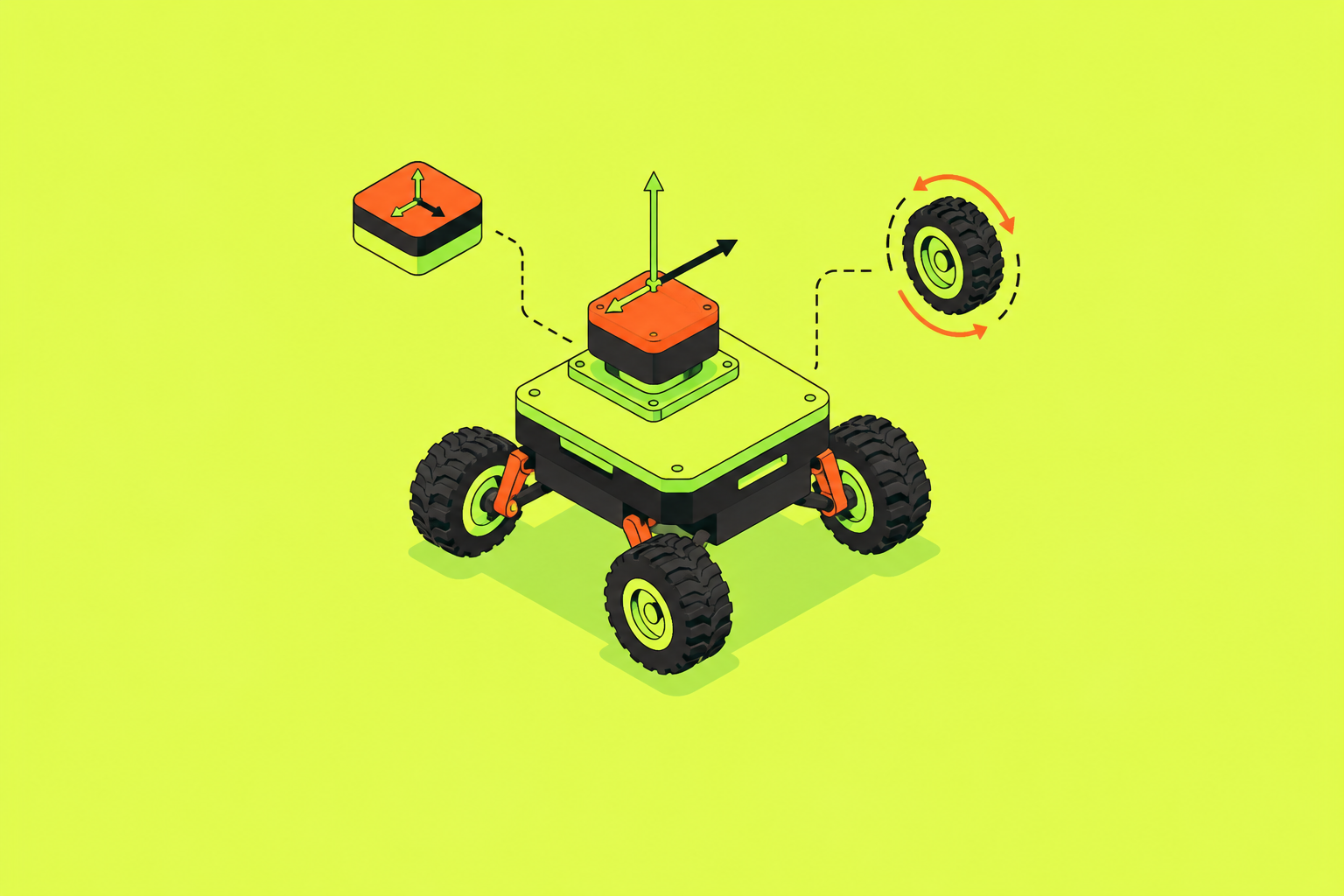
The ZED 2 also includes an IMU, magnetometer, and barometer for SDK-based 6-DoF positional tracking and sensor fusion. Those sensors are more directly useful for mobile navigation than for an arm camera on a fixed mount. Nardon et al.’s 2025 CHIP dataset used the D435, ZED 2i, and Intel RealSense L515 together for 6D pose estimation of chairs in an industrial robotic arm setting. That combination shows how active stereo, passive stereo, and LiDAR can work together.
What the ZED SDK adds beyond raw depth — and what it costs the integrator
The GPU requirement supports more than stereo depth computation. The ZED SDK integrates positional tracking, spatial mapping, object detection, and body tracking as out-of-the-box capabilities. For a mobile robot that needs those functions, the camera and SDK provide an integrated software path alongside a stream of depth measurements. The value is particularly direct when a suitable GPU already exists on the platform.
For applications requiring SLAM, the ZED 2 offers an end-to-end pipeline through the SDK that the D435 does not provide natively. D435 users instead build SLAM pipelines from separate parts. That distinction shifts both the integrator’s work and the hardware budget. The ZED 2’s built-in motion and environmental sensors feed the SDK’s tracking and sensor fusion, linking its sensor suite to the navigation software. In return for those integrated functions, the robot accepts the NVIDIA compute dependency established earlier.
A robot that needs only close-range depth has a different integration problem from one that also needs mapping and tracking. The SDK can reduce the separate engineering required for its supported functions, but it cannot manufacture natural scene texture for passive stereo.
The corporate continuity risk that changes the D435's long-term deployment calculus
The RealSense division’s corporate transition adds uncertainty outside the optical and compute comparison. For teams designing platforms with multi-year production horizons, supply and support continuity are material concerns. The camera’s measured performance does not resolve them. A sensor can remain technically appropriate while the institutional basis for a long deployment becomes less certain. This risk attaches to the platform decision while the D435’s measured depth quality remains unchanged.
Stereolabs and the actively maintained ZED 2i production line have no comparable transition underway in the account provided here. That creates an asymmetric continuity consideration between the two choices. What happens to the RealSense line beyond the stated transition is still unknown. For long-horizon deployments, the relevant action is to evaluate supply and support uncertainty together with performance, rather than allowing either one to stand in for the other.
Matching architecture to application: a decision framework based on deployment conditions
The practical decision process should begin with host eligibility and then move through operating distance, environment, and mounting constraints. If the robot lacks suitable NVIDIA compute and cannot accommodate it, the ZED 2i is not a depth-sensing option on that platform. That branch closes before accuracy becomes relevant. If suitable compute is available, next consider where the robot must obtain useful depth.
For manipulation under one meter on an embedded or ARM host, the D435 is the architecture-appropriate choice, particularly where projected texture supports uniform indoor surfaces. Its on-board processing and compact body align with that deployment, while the study provides close-range empirical support. Outdoor navigation takes the decision in another direction. For longer-range mobile sensing with suitable NVIDIA compute, the ZED 2i combines the more appropriate passive architecture with integrated tracking and SLAM. Strong sunlight makes the D435’s IR projection limitation a hard constraint.
Indoor mobile navigation requires a more conditional choice. Where low light and textureless surfaces dominate, the D435’s projector gives it an optical advantage even if a GPU is available. The ZED SDK may still motivate accepting that lighting limitation or supplementing illumination to obtain its integrated navigation functions. Payload-limited and wrist-mounted configurations favor the D435, while multi-year production plans require a separate evaluation of RealSense supply and support continuity. The final choice follows the deployment’s binding constraint.
Sources
- Empirical Comparison of Four Stereoscopic Depth Sensing Cameras for Robotics Applications
Published IEEE Access version of the comparison, the source of the 3,000-frame test design and the distance-dependent accuracy results.
- Empirical Comparison of Four Stereoscopic Depth Sensing Cameras for Robotics Applications
Preprint of the four-camera comparison that supplied the under-1 cm close-range and under-3 cm at 4 m error results, plus the camera size and mass figures.
- (PDF) Empirical Comparison of Four Stereoscopic Depth Sensing Cameras for Robotics Applications
Another copy of the four-camera comparison covering the same close-range and long-range accuracy findings.
- CHIP: A multi-sensor dataset for 6D pose estimation of chairs in industrial settings
Described the CHIP dataset, which used the D435, ZED 2i and L515 together for 6D chair pose estimation.
- (PDF) Perspectives of RealSense and ZED Depth Sensors for Robotic Vision Applications
Offered a general comparison of RealSense and ZED sensors for robotic vision, informing the architectural and compute trade-offs.
- [2501.07421] Empirical Comparison of Four Stereoscopic Depth Sensing Cameras for Robotics Applications
Abstract page of the four-camera comparison, summarizing its overall findings on the ZED 2 and RealSense cameras.
- ZED 2i
Supplied the ZED 2i product and pricing context relative to the D435i.
- ZED 2 - AI Stereo Camera
Provided the manufacturer's ZED 2 specifications, including depth range, sensor suite and SDK capabilities.