Structural Material Selection for Lightweight Robot Arms
Weight cascades through every metric that matters in robot arm performance.
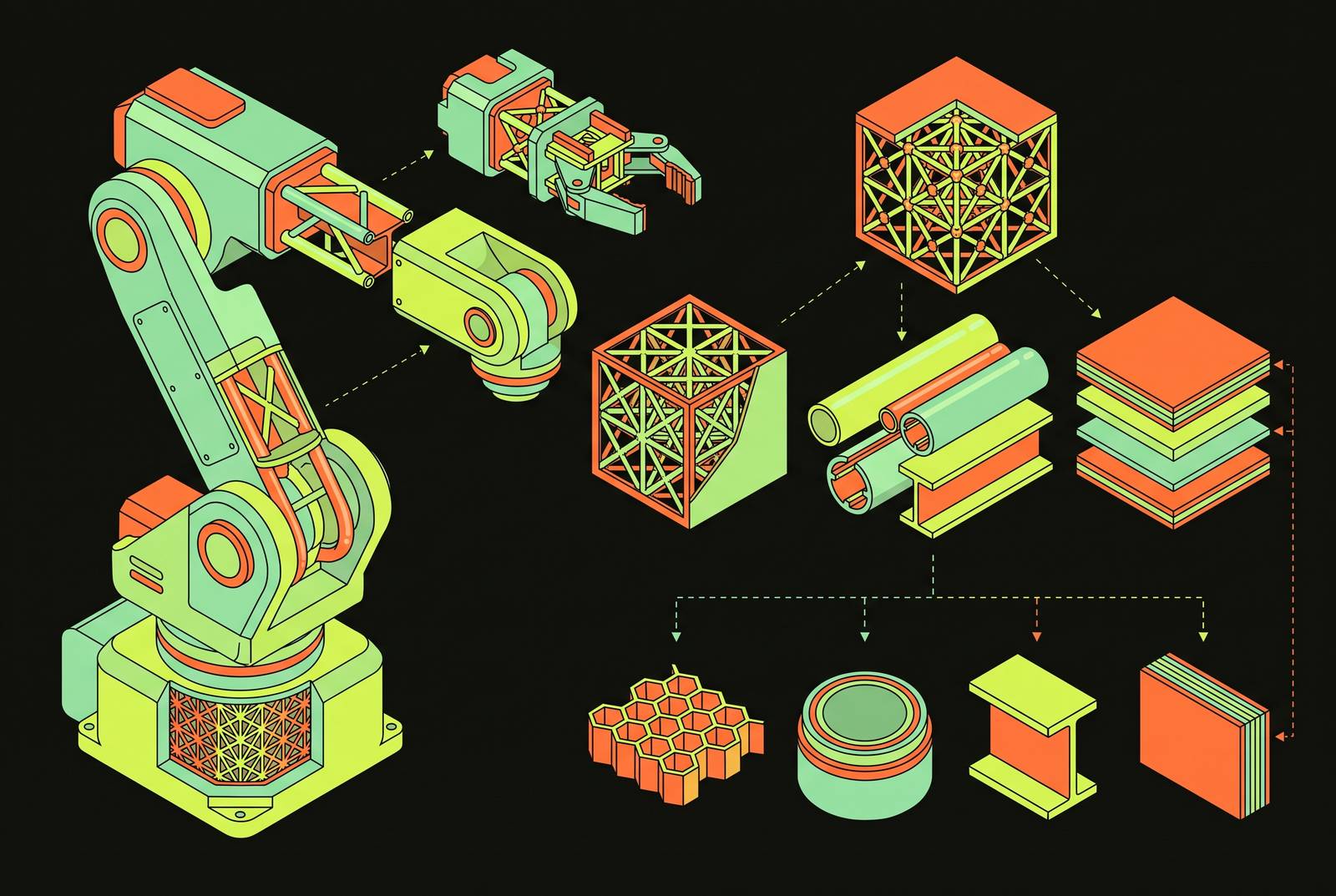
Weight decides almost everything else about how a robot arm performs. Every gram added to a link has to be moved, stopped, and moved again, thousands of times a day, and whatever material builds that link decides how much of the arm's energy goes toward useful work versus fighting its own mass. This piece works through the main candidates, aluminum, carbon fiber, titanium, and hybrid combinations, and lays out where each one actually earns its place, and where engineers keep choosing it out of habit rather than fit.
Four things get worse at once when an arm gets heavier: operating speed, reach under load, bearing life, and how much payload is left over to actually carry. There's no scenario where added mass helps one of these without punishing the rest. A heavier arm moves slower for a given motor, sags more under the same load, wears its bearings out faster under repeated reversals, and has less capacity left to do the job it was built for.
Running the numbers on a typical pick-and-place cycle shows the stakes are not abstract. A robot doing 28,800 cycles a day sits well within normal industrial duty, and at that pace the arm crosses into the 10-million-cycle range in under a year. That figure lands deep in high-cycle fatigue territory for metals, the zone where long-term durability, not peak strength, decides whether a part survives its service life.
The dynamic penalty compounds instead of just adding up. A heavier distal link needs a bigger motor to accelerate and decelerate it, but a bigger motor weighs more, too, so the arm now has to move even more mass, which calls for a still-bigger motor. Cutting mass at the wrist or forearm lets every upstream joint, actuator, and gearbox shrink in response, since the whole system was sized around a heavier load path to begin with. Designers who miss this tend to fix the wrong joint first.
The application contexts that determine which trade-offs are acceptable
No single material wins across every job, because different applications put weight at different spots on the priority list. Pretending otherwise is how a lot of arms end up over-engineered in the wrong direction.
Heavy industrial arms doing welding, stamping, or palletizing lean on base stiffness and cost control over raw weight savings. Near the pedestal of a large arm, mass barely matters, so steel still holds up fine as a structural column. Mid-range manufacturing and research arms sit in a different spot, balancing stiffness, weight, machinability, and cost all at once, and this is the segment where aluminum has been the default for decades, largely because nothing forces a change. Collaborative robots, humanoids, and mobile platforms flip the list again: low inertia and safety around people come first, and for humanoids especially, cutting mass at the distal end of the arm rewrites the whole dynamic budget. This is the fastest-growing corner of the robotics market, expanding at roughly 20% a year in unit terms and now making up close to 11% of all industrial robot installations.
Medical and aerospace robotics bring constraints that show up nowhere else on this list: biocompatibility and contamination-free operation. Those two requirements alone justify titanium and specialty composites at a real cost premium, because there isn't a cheaper substitute that meets the requirement.
Production volume shapes the decision as much as the application does. An integrator building a dozen custom brackets a quarter faces a completely different cost structure than a cobot manufacturer turning out thousands of identical arms, even when both are technically building the "same" part from the "same" material. Geography adds another layer. Asia-Pacific held 47.3% of the carbon fiber robotic arm market in 2025, concentrated around high-volume manufacturers like ABB China, KUKA Asia, Yaskawa, and FANUC, while Europe held 30.4% at lower volume but tighter per-unit precision demands. The same composite layup can pencil out in one of those markets and lose money in the other, purely on the economics of scale.
Aluminum alloys: the long-standing default and its breakdown points
Aluminum earned its default status the ordinary way: it works, it's familiar, and it's cheap enough at moderate volumes. At 2.7 g/cm³ it runs about a third the density of steel, machines on equipment every job shop already owns, resists corrosion without extra coating steps, and posts specific stiffness around 26 GPa/(g/cm³), the number every other material in this piece gets measured against.
Grade selection inside that family isn't a minor detail, and treating all aluminum as one material is a common mistake. 6061 covers most general arm bodies and structural links, with machinability and strength that hold up for the bulk of everyday design work. 7075 steps in at high-stress joints and precision hardware, where its higher yield strength earns its keep. AlSi10Mg is another option in the family, suited to additive manufacturing and picked for 3D-printed components on the strength of its weight-to-cost ratio.
Fatigue is where aluminum hits a wall no amount of clever design gets around. Unlike aluminum, which has no true fatigue floor: every cycle, however mild, eats a sliver of the part's fatigue life. At 28,800 cycles a day, this is the actual reason aluminum arms accumulate fatigue damage at stress concentrations that were never overstressed on any single pass. Anyone specifying aluminum for a high-cycle application without running a fatigue curve first is gambling with the service warranty.
Carbon fiber composites: the specific stiffness advantage and its cost
Carbon fiber's case rests on one number. A quasi-isotropic CFRP layup reaches roughly 40 to 50 GPa/(g/cm³) in specific stiffness, close to double aluminum's baseline. That means a CFRP arm can match an aluminum arm's stiffness at half the weight, or match its weight while coming out stiffer, and the engineer gets to choose which side of that trade to take.
The gains appear in built parts, not just lab coupons. Swapping aluminum frames for CFRP has cut mass by 40% to 60% while holding strength steady in documented redesigns. Documented redesigns bear this out: one reported case found a CFRP arm came in 42.3% lighter than its aluminum counterpart, held its structural performance, and cut inertia sharply enough to change the arm's dynamic response.
Fatigue behavior is the other argument, and arguably the more durable one. A well-designed composite carries load through elastic fibers rather than a metal crystal lattice, so it never accumulates the dislocation damage that eventually cracks aluminum. At stress levels typical of robotic arms, that means fatigue life effectively without limit, which removes aluminum's dominant failure mode from the equation.
Peer-reviewed optimization work backs this with numbers. Ghazi Kareema and colleagues optimized a six-degree-of-freedom arm built from a fiber-reinforced composite, running FEM alongside gradient-based optimization. Modal analysis put the composite design's natural frequencies above the aluminum baseline, and end-effector load capacity rose by as much as 30%.
None of it is free. CFRP tooling and layup cost more, cycle times run longer for anything beyond a simple tube or panel, and the material punishes design mistakes (a mis-oriented ply, a poorly placed cutout) in ways aluminum tolerates. CFRP rewards a redesign, not a substitution; treating it as a drop-in aluminum replacement misses the point.
Thermoplastic carbon fiber composites as a manufacturing and sustainability variant
Thermoplastic CFRP is a distinct branch of the composite family with its own identity. It recycles, takes impact better, resists chemical corrosion, and cures in 3 to 5 minutes against 120-plus minutes for a typical epoxy system, a gap wide enough to change the economics of high-volume production on its own.
Storage tells a similar story. Thermoplastic prepreg has effectively no shelf-life limit, while thermoset prepreg carries its own storage and shelf-life constraints. That's real cost and real material waste that thermoplastic simply sidesteps.
None of this comes free, though. CFRTP generally trails conventional thermoset CFRP on raw mechanical strength, and closing that gap is still an open research question, not a solved one. Choosing thermoplastic means accepting a real performance concession in exchange for easier manufacturing and a cleaner end-of-life path, not banking both advantages at once.
Industry is already moving on the trade. Mitsubishi Chemical, working with a Japanese robot manufacturer, developed recyclable thermoplastic composite arm segments in the third quarter of 2023, cutting end-of-life waste by 67%. Broader adoption of thermoplastic composites in high-volume collaborative robots is forecast for the 2030 to 2033 window, and that timeline looks conservative given how fast cure times are already falling.
Titanium: performance relative to aluminum and composites
Titanium's pitch is strength-to-weight comparable to high-strength steel at roughly 40% less mass, paired with corrosion resistance and biocompatibility that neither aluminum nor CFRP can match. That last property opens the door to medical robotics applications where composites simply aren't an option, full stop.
In practice, titanium is used in specific spots rather than across whole arms: forearm assemblies and wrist joints on high-speed handling equipment and precision aerospace robots. Those are the distal components where shaving mass pays off most in reduced inertia and faster settling time, so the material gets used exactly where its cost premium buys the biggest dynamic return, and nowhere else.
Demand data from 2025 backs up where the market is pointing. Ti-6Al-4V orders jumped 217% year over year in the first quarter of 2025, driven mainly by humanoid robotics programs, making titanium the fastest-growing structural metal in the sector by that measure.
Machining is the honest limit on how far it spreads. Titanium is harder to cut and far more expensive to machine than aluminum or steel, and that alone keeps it out of general-purpose arm structures. It stays confined to the joints and sections where the performance payoff clears the manufacturing bill, and anyone specifying it for a full arm structure is paying for a benefit most of that arm will never use.
Hybrid CFRP/aluminum structures and the optimization problem of combining materials
Hybrid structures exist because neither material solves the whole problem alone. CFRP costs more and is harder to process into complicated shapes; aluminum machines easily but carries more density than an arm's dynamics usually want. Splitting the structure lets each material sit where its strengths actually apply, instead of forcing one material to do a job it isn't suited for.
The usual split puts CFRP skins or tubes on bending- and tension-dominated sections, where fiber orientation can be tuned to the load path, and puts aluminum or steel at the machined joints, fastener interfaces, and compression-loaded connections, where isotropic behavior and easy machining determine how well the joint performs and how easily it can be produced, outweighing raw specific stiffness.
One documented example, a co-cured camera gimbal built from a 1 mm CFRP skin over a 1.5 mm aluminum core, achieved about 28% weight savings against a solid aluminum equivalent. That's a modest gain next to a full composite redesign, but it costs a manufacturing price between pure aluminum and pure CFRP, which is exactly the appeal for programs that can't absorb full composite tooling costs.
None of this is improvised. The CFRP/aluminum-alloy hybrid arm structure has been proposed specifically as the output of multi-objective optimization aimed at minimizing total arm mass. The material split is a calculated result of that process, derived directly from the optimization itself.
Finite element analysis and topology optimization in translating material choice into geometry
Picking a material only sets the ceiling on what an arm can do. Geometry decides how much of that ceiling gets used, and a badly shaped CFRP arm can lose to a well-optimized aluminum one despite the raw material advantage on paper.
Finite element analysis is the standard tool for closing that gap before a part gets built: stress analysis, natural frequency prediction, and displacement checks under load are routine steps in composite arm design now. As Nagar, Ali, and Mahate describe it, FEA has become a powerful computational tool for structural analysis and optimization of robotic components, and that holds regardless of which material ends up in the final design.
Topology optimization fits aluminum and hybrid structures best, since it strips material out of low-stress regions while keeping load paths intact, and since machining or casting can actually produce whatever odd shape the optimizer spits out. It applies less directly to continuous-fiber composites, where the shape of the part matters less than the direction the fibers run.
For composites, ply angle optimization is the real lever, not part geometry. The [90°/−45°/0°/45°] layup used by Hou and Zhang wasn't chosen by feel: it came out of a multi-level optimization process running from free-size optimization through layer thickness down to layer order. The SMEAR super-layer method makes that whole optimization computationally tractable, before a single ply gets cut.
Matching material to application: a decision framework across the candidate set
Lining the candidates up against their contexts reveals a pattern on its own, and it's a pattern most procurement decisions still ignore. Heavy industrial arms with big static loads and thin cost margins still favor aluminum, or steel at the base, because weight isn't the limiting variable there and the machining infrastructure already exists. Mid-range manufacturing and research arms sit closest to a genuine toss-up between aluminum and CFRP, and production volume usually settles it: composite tooling needs enough units running across it to pay for itself.
Cobots, humanoids, and other low-inertia, safety-driven platforms point toward CFRP or thermoplastic composite, since fatigue life and distal mass drive the material choice over cost per part. Medical and aerospace work pulls toward titanium wherever biocompatibility or contamination control is a hard requirement, cost premium included, because no substitute material meets that bar.
Hybrid CFRP/aluminum construction earns its place wherever an arm has clearly separate zones of bending load and machined-joint load that can be split between materials without a full redesign. None of these choices are permanent. As thermoplastic cure times keep falling and titanium machining costs keep responding to humanoid-driven demand, the boundaries between these categories will keep moving. But the underlying framework, specific stiffness against density against fatigue life against fabrication cost, stays the fixed standard against which every new material gets measured, and any team skipping that comparison is choosing by habit, not by engineering.
Sources
- Dynamic optimization of a composite material robot arm using a flexible link and joint model - ScienceDirect
- (PDF) Weight Optimization of Robotic Arm using FEA: A Review Paper
- (PDF) Lightweight design of industrial robot arm based on thermoplastic carbon fiber reinforced materials
- iopscience.iop.org
- Hybrid Structure Design of Lightweight Robotic Arms Based on Carbon Fiber Reinforced Plastic and Aluminum Alloy
- cfrp-tstar.com