Bearing Selection for High-Cycle Robot Joint Applications
Control algorithms mask bearing wear until failure strikes suddenly.
A robot joint bearing rarely dies the way its catalog rating says it should, and the reason starts inside the control system itself. As wear increases friction at the joint, the robot's control algorithm compensates by commanding higher motor current to hold the commanded trajectory, so the mechanical degradation stays hidden from anyone reading torque or position data until failure is close at hand. That masking effect is the clearest sign that the standard L10 life calculation, built for constant-speed, unidirectional rotation, does not describe what actually happens inside a joint. Three conditions push joints outside those assumptions at once: dithering micro-oscillations that strip the lubricant film, high overturning moments generated by the arm's lever geometry, and rapid start-stop inertia that leaves no tolerance for internal clearance. Most bearings that fail early still look, on the bench, like a textbook fatigue case: spalling, surface pitting, the kind of damage an engineer expects at end of life. The actual cause is usually lubrication breakdown, contamination, or a mounting error, not a load that exceeded the bearing's rated capacity. A common design mistake compounds the problem: sizing a joint bearing against static load alone, without accounting for moment load or the compliance of the housing it sits in. The better practice works backward from the tool center point, calculating the tilt the application can tolerate there, then tuning preload and flange thickness so the stiffness on paper is the stiffness the assembled joint actually delivers.
The three failure mechanisms that govern joint bearing life
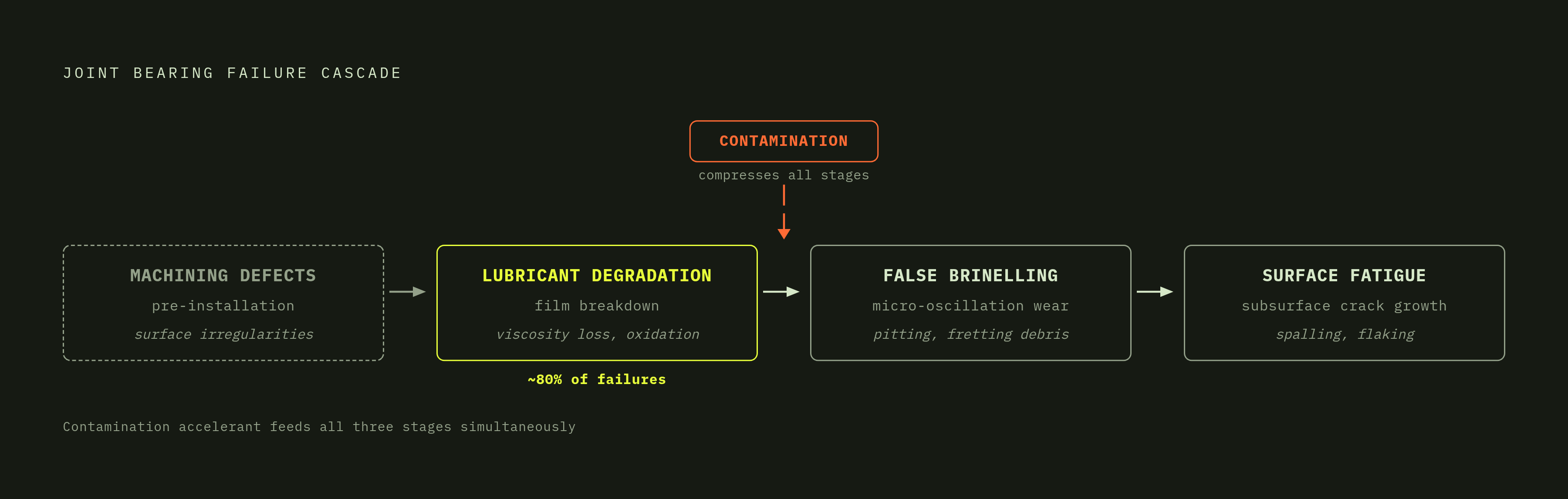
Surface fatigue, false brinelling, and lubricant degradation don't operate as three separate failure categories to check off a list. They form a chain, and each one makes the next one arrive faster. Surface fatigue, commonly seen as spalling, begins as a subsurface crack that propagates up to the raceway and flakes material away. It's the failure mode every bearing is expected to reach eventually, but when it occurs early it tells the engineer something: that real load exceeded the design assumption, that the lubricant film was thinner than it needed to be, or that internal clearance was set wrong from the start.
False brinelling follows a different path. In joints that dwell or oscillate across a narrow arc rather than completing full revolutions, micro-oscillation strips the lubricant film away in the exact spot the bearing keeps returning to, producing localized wear that looks like an indentation even though no impact occurred. This is the dominant failure mode in wrist and shoulder joints, which by their kinematic role rarely rotate all the way around.
Lubricant degradation is the root cause behind both other mechanisms: tribological research cited by Torquety puts it behind roughly 80 percent of premature bearing failures, and once the film breaks down, surface fatigue and false brinelling accelerate together rather than independently. Contamination acts as the accelerant that ties all three together: a hard particle rolled into the raceway first dents it, then abrades it on every subsequent pass, compressing the timeline of all three failure modes at once. In practice this traces back to a seal that failed or was never specified correctly for the environment. The chain can also start before the bearing is ever installed. Surface and sub-surface defects introduced during machining, including in parts that pass every dimensional inspection on the floor, can initiate the first fatigue cracks under cyclic rotary load well before the joint sees its first duty cycle.
The reason this interconnection matters for selection is straightforward: a bearing chosen purely to resist fatigue load, without regard for oscillation amplitude or how often the lubricant gets replenished, will still fail. It just fails by a different route, through false brinelling or lubricant starvation instead of the fatigue mode the designer planned for.
Bearing Type and Dominant Failure Risk by Joint Position
The physical position of a joint, shoulder, elbow, or wrist, sets which of the three failure mechanisms is most likely to dominate, and that risk profile should drive the architecture choice more than catalog load capacity does. No single bearing family wins across every position; each one trades one kind of resistance for vulnerability to another.
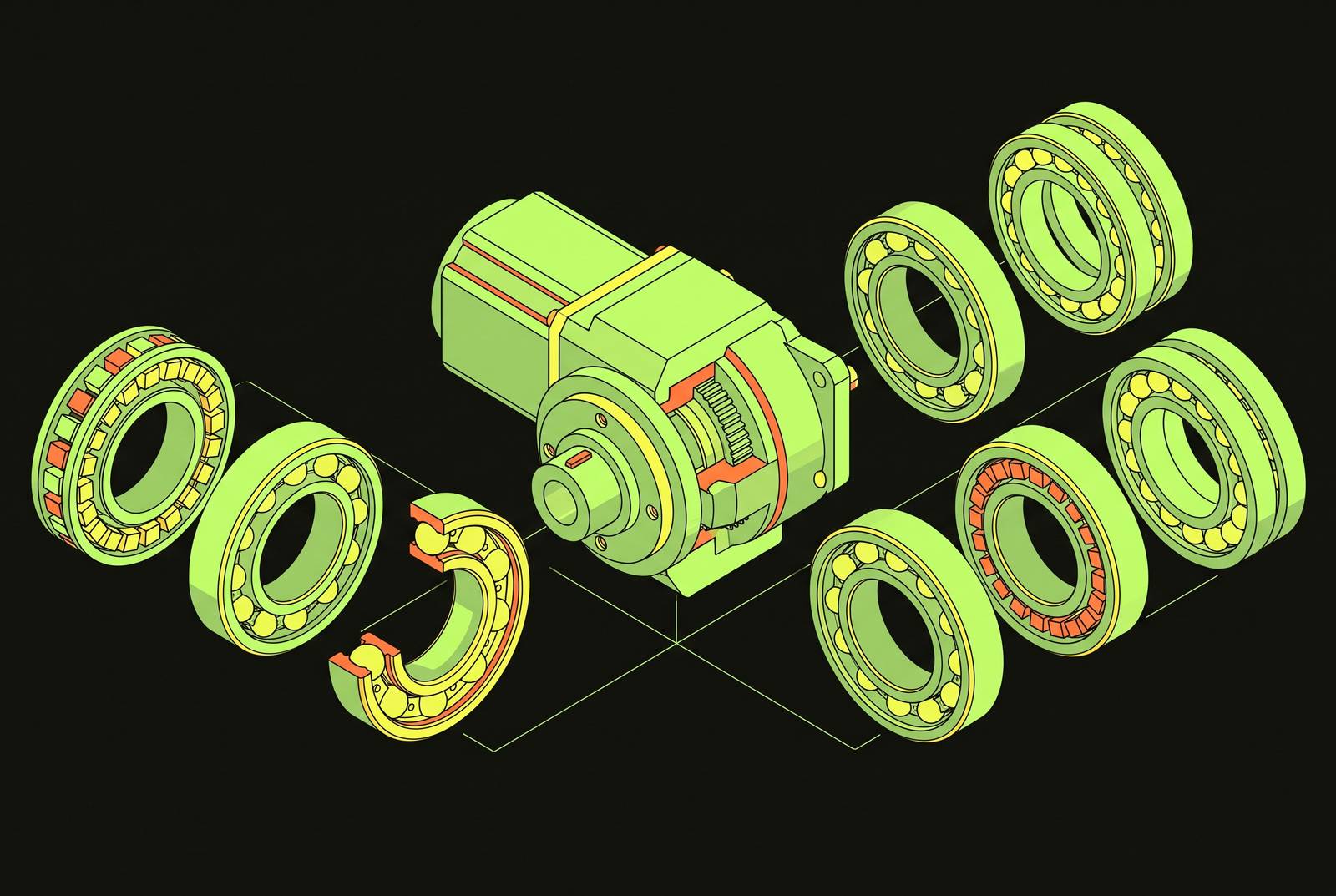
Crossed roller bearings arrange rollers in alternating 90-degree patterns inside a compact ring, letting them carry radial load, axial load, and moment load simultaneously. Their minimal internal clearance makes them the standard choice for shoulder pivots, wrist joints, and high-precision pick-and-place axes, where moment stiffness is the governing requirement. That same compactness limits how much lubricant the bearing can hold internally, which raises the risk of false brinelling in joints that oscillate across a narrow arc rather than completing full rotations.
Schaeffler's INA XZU series occupies the same external envelope as a crossed roller bearing but takes a different internal approach: two separate raceways increase the support distance and add rigidity, while cage-guided rolling elements cut friction and open up more room for lubricant. In joints where oscillating duty makes lubricant retention the limiting factor, that extra volume is a direct answer to the weakness crossed roller bearings carry.
Angular contact ball bearings suit high-speed rotary joints carrying combined radial and axial loads. Their lower friction compared to roller designs generates less heat, which slows lubricant degradation and makes this architecture the stronger choice where thermal stress driving surface fatigue is the dominant risk rather than moment load.
Thin-section bearings, the Kaydon Reali-Slim series among them, hold the same cross-section regardless of bore diameter, which makes hollow-shaft designs possible for routing cable and tubing through the joint itself. They carry less stiffness than a crossed roller bearing at the same outer diameter, so the stiffness of the surrounding housing becomes a design variable in its own right rather than an afterthought. That tradeoff suits lighter-load wrist and end-effector joints, where minimizing weight and inertia matters more than maximizing moment capacity, and PIB Sales identifies lightweight robots where payload and low inertia are the primary design drivers as the natural fit for thin-section architecture.
Deep groove ball bearings round out the picture for auxiliary axes and light-duty joints. Their moment capacity is limited enough that most designs pair them in a dual-bearing spacing arrangement to handle overturning loads that a single bearing couldn't resist alone. Across every one of these families, precision class carries its own weight: P4 or P5 tolerance classes cut runout and internal play, which directly limits the tilt measured at the tool center point and therefore the repeatability the whole joint can deliver. None of these architectures is a universal default. Each one answers a different failure risk, and the joint's kinematic role and duty cycle decide which answer fits.
Preload strategy as the most consequential and most misapplied variable in joint bearing selection
Even a correctly chosen bearing architecture fails if its preload is wrong, and preload is the one variable that touches all three failure mechanisms at the same time. Too little preload leaves clearance in the joint that accelerates false brinelling. Too much generates contact stress and heat that degrade the lubricant and compress the bearing's fatigue life. Standard catalog preload classifications, labeled "light" or "medium," are built around a generic operating condition and get applied to specific joints without reference to that joint's actual duty cycle or operating temperature.
Preload done right improves rigidity, removes internal clearance, and stabilizes positioning accuracy. Preload done wrong raises contact stress, friction torque, and heat generation, shortening the service life it was meant to extend. Harron Bearing's engineering practice treats this as a reason to work directly with a bearing supplier to calibrate preload against the joint's real operating temperature and duty cycle, rather than accepting whatever the catalog default happens to say.
The thermal side of this problem is the hinge the rest of the selection process turns on. As a joint's operating temperature rises, thermal expansion changes the bearing's effective preload in ways a room-temperature calibration can't anticipate. Conventional steel loses dimensional stability above 120°C, so a preload set carefully on a cold bench can look very different once the joint has been running for an hour. That shift destabilizes the lubricant film thickness that keeps false brinelling and surface fatigue in check. This is why material selection, covered next, cannot be separated from the preload decision.
Torque-controlled cobots make this sensitivity concrete in an immediate way: preload drift causes torque ripple that appears in the control system as a force control error, which the system has no easy way to distinguish from a genuine change in payload. In that context, preload stability is no longer just a life-extension concern but a functional requirement for the robot to do its job correctly. At the hardware level, a Samsung Electronics patent takes on this problem directly, describing a threaded dual-housing arrangement that allows the outer ring to be adjusted axially, letting preload be set and maintained without taking the joint apart.
The most common objection to calibrating preload per joint is cost: it adds engineering time and slows procurement compared to pulling a standard catalog value off the shelf. That objection doesn't hold up well against the alternative. A single unplanned downtime event caused by premature failure costs more than specifying the joint correctly at design time would have.
How bearing material choices alter which failure mechanism dominates
Material choice sets the temperature ceiling at which preload, lubricant film, and dimensional accuracy all stay stable, and that ceiling effectively decides which of the three failure mechanisms a designer is accepting as the limiting one for a given joint. Conventional steel, standard chromium steel or its SUJ2 equivalent, loses dimensional stability above 120°C. In a high-cycle joint where motor and reducer heat accumulates steadily, that threshold gets crossed routinely: preload shifts, the lubricant film thins, and surface fatigue accelerates as a direct result.
Advanced alloys push that ceiling much higher. JIA Bearing's 2026 guide describes SKF's ARCTIC15 steel alloy as holding P2 tolerance and HRC 60+ hardness up to 400°C, with a claimed L10 life five times longer than traditional M50 steel. That improvement targets the thermal-instability chain specifically, the sequence where heat destabilizes preload, preload destabilizes film thickness, and film loss accelerates fatigue.
Hybrid ceramic bearings, built from silicon nitride balls running in steel rings, take a different route to the same problem. Lower density than steel cuts the joint's weight and inertia, while superior hardness and friction resistance slow the rate at which the lubricant degrades. Silicon nitride holds a dominant share of the hybrid ceramic bearings market as of 2025, and SKF showcased hybrid ceramic bearings built for robot joints at the 2025 Hannover Messe, demonstrating lower friction torque and higher speed capability alongside integrated oil condition monitoring.
Self-lubricating polymer composites address the problem from the lubrication side rather than the thermal side. They're gaining ground in cobots and mobile robots where maintenance access is limited, because they intervene directly in the lubricant degradation chain by making the bearing partly self-sufficient. That comes at the cost of lower load capacity and stiffness compared to steel or ceramic designs, so the tradeoff only makes sense where maintenance access, not load, is the binding constraint.
At the smallest scale, humanoid robot hands run on miniature bearings in stainless steel, available from 2 mm bore upward in shielded or open configurations depending on how exposed the mechanism is to contamination. At this scale, thermal stability isn't the dominant concern; contamination control is. PIB Sales' 2025 guide lists the Mitsumi series used in these mechanisms, spanning from the L-520ZZW52 at 2 mm bore in SUJ2 with a shielded design, up to the DDL-1280H at 8 mm bore in stainless steel with an open design, which gives a sense of how wide the range of material and sealing choices gets even within a single robot hand.
None of these materials is a universal upgrade. Advanced alloys and ceramics carry real cost and supply-chain implications, and the right choice follows from the failure mechanism the joint's thermal environment makes most likely rather than a default preference for whatever material is newest. A ceramic hybrid bearing still needs a lubricant matched to its own thermal and chemical properties. Pairing a high-temperature alloy with a grease formulated for lower temperatures cancels out the material's advantage before the joint ever sees service.
Lubrication selection and interval as the direct control variable for all three failure mechanisms
Lubricant degradation causes roughly 80 percent of premature bearing failures and accelerates the other two mechanisms once it starts, which makes lubrication selection and replenishment interval the highest-leverage decisions in this framework after architecture and preload are settled. In narrow-arc oscillation, false brinelling follows a direct mechanical logic: if the lubricant film isn't replenished before it shears away under repeated micro-movement, metal-to-metal contact begins, and the indentation pattern that defines false brinelling follows from there.
Base oil viscosity has to match the joint's operating speed and temperature in both directions. Too high a viscosity at operating temperature increases churning losses and generates more heat, feeding the same thermal degradation chain discussed above. Too low a viscosity at low temperature fails to build a protective film at startup, which is precisely the moment contact stress is highest.
Grease and preload can't be specified separately from each other. Harron Bearing's engineers point out that a common pattern, upgrading the bearing's grease grade to solve a precision problem, usually turns out to be a preload-plus-grease stability issue rather than a grease quality issue on its own. Torque drift in torque-controlled joints is a symptom, not the underlying cause.
Manufacturer standard replenishment intervals describe a generic case, and duty cycle, oscillation amplitude, and operating temperature all shorten effective grease life well below what the catalog assumes for a given joint. One of the more useful field indicators doesn't require any new sensor hardware at all: trending motor current over time reveals changes in bearing drag and lubricant depletion directly, the same signal that masked early wear in the opening section now becomes the tool for catching it. For cobots and mobile robots where maintenance access is limited, self-lubricating polymer composites eliminate the need for a service interval at the structural level, trading away some load capacity and stiffness in return.
How sensing integration changes bearing selection in practice
Embedded sensing doesn't replace the failure-mode-first framework built across the sections above. It changes what's observable while that framework is in use, turning lubrication interval and preload drift, the two inputs that vary the most once a robot is in service, into things that can be measured continuously instead of estimated once at design time.
NSK announced in February 2026 that it had built a third-generation joint bearing module for a leading North American humanoid robot company, integrating a torque sensor and temperature monitoring directly into the bearing assembly. That announcement reflects a broader shift toward smart bearing systems, which industry analysis credits with reducing unplanned downtime by up to 50 percent. In this design, the bearing acts as an active sensing element inside the joint's control loop rather than a passive rotating part.
The failure-mode-first framework doesn't disappear once sensing is added. Architecture still has to match the joint's kinematic role, preload still has to be calibrated against real operating temperature, and material still has to be chosen against the thermal ceiling the duty cycle demands. What sensing changes is the engineer's position relative to that framework: instead of predicting, at design time, how fast lubricant will degrade or how preload will drift under heat, the engineer can watch both happen in real time and respond before the chain from lubricant degradation to false brinelling to surface fatigue has run its course.