NVIDIA Jetson Orin vs Intel NUC for Robot Edge Inference
NVIDIA's purpose-built AI chip outperforms Intel's general PC approach for robots.
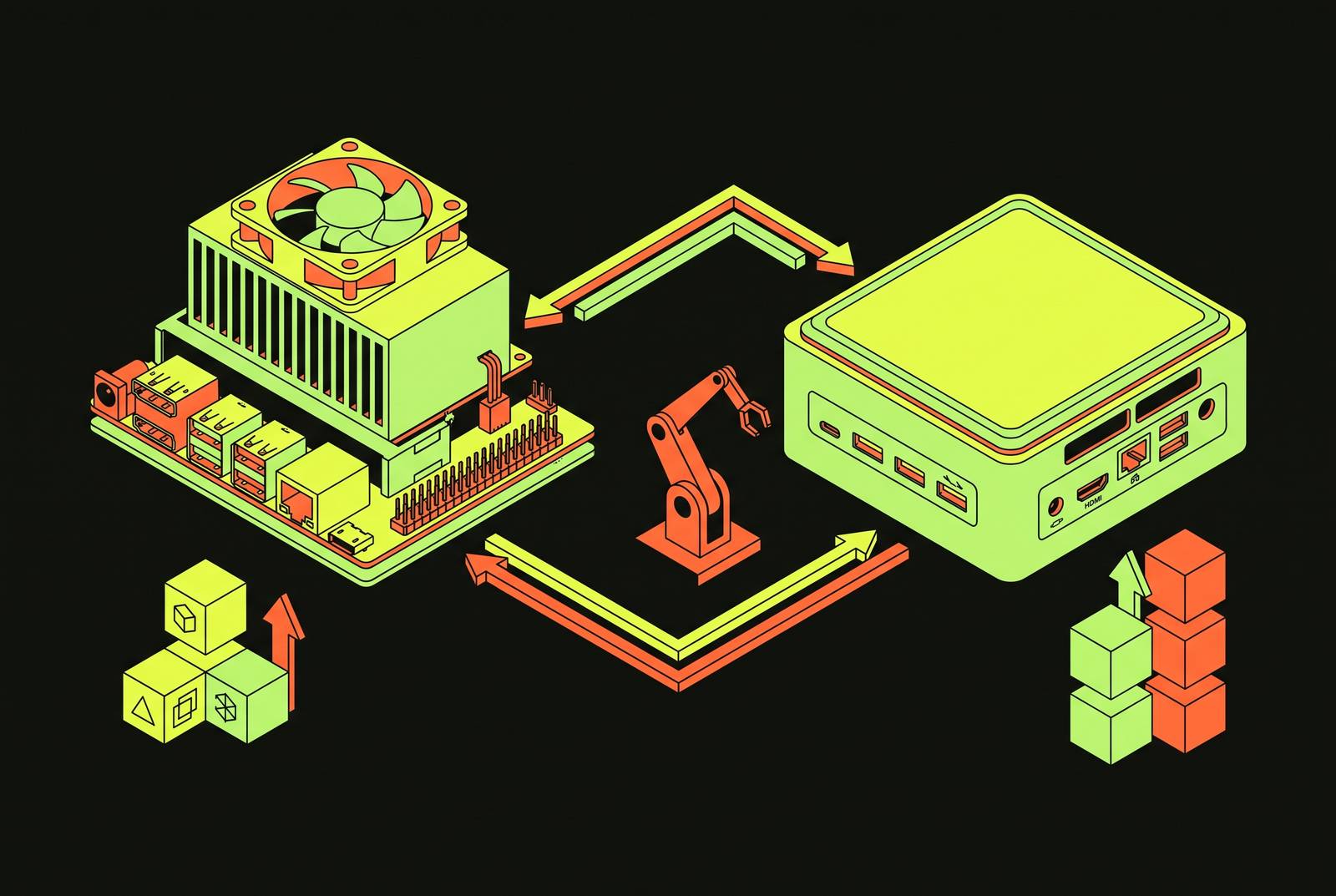
Robot builders picking between Jetson Orin and an Intel NUC aren't really choosing a processor. They're choosing between two opposite bets on what edge AI hardware should be: one bet says build the chip around the neural network from the transistor up, the other says take a general-purpose PC and bolt on enough AI hardware to compete. Both bets have paid off in different corners of the robotics market, and the split between them tells you more about a project's constraints than any single benchmark can.
Jetson Orin vs Intel NUC: A Design Philosophy Question
Which board is faster depends entirely on what you're running. Asking which design philosophy fits the robot in front of you gets you somewhere useful.
NVIDIA's Jetson line is a system-on-module built from the silicon up around neural network math: Tensor Cores for matrix operations, dedicated DLA engines for inference acceleration, a unified memory architecture shared across compute blocks, and camera interfaces integrated into the chip. None of that is bolted on after the fact. It's the reason the architecture exists.
The Intel NUC comes from the opposite direction. It's a general-purpose x86 mini PC that has picked up an NPU and a capable integrated GPU to handle AI workloads as they became unavoidable. The chassis, the OS assumptions, the driver model: all of it still behaves like a desktop machine that learned a new trick.
Neither approach is the wrong one in the abstract. Each fits a different set of constraints: power budget, physical size, how deep the compute needs to sit inside the robot's chassis, and how mature the software stack needs to be on day one.
The current Jetson Orin lineup: what each tier delivers
NVIDIA currently ships four Orin tiers, with a fifth announced but not yet available.
The entry point is the Jetson Orin Nano Super, at $249 for the developer kit. It delivers 67 TOPS of AI performance, a 1.7x jump over the original Nano that NVIDIA achieved almost entirely through software: JetPack 6.2's "Super Mode" simply raises the clock frequencies on the GPU, CPU, DLA, and memory. No new silicon, just a firmware update that made existing hardware faster. That's a rare thing in embedded computing, where performance gains usually mean buying a new board. It also signals something about how NVIDIA is running this ecosystem: existing customers get upgraded for free. The Nano Super carries 8GB of unified memory and runs up to 25W.
Step up to the Jetson Orin NX 16GB and Super Mode pushes performance to 157 TOPS, with an 8-core CPU and expanded DLA support over the Nano. It ships as a bare module, not a complete board, so it needs a carrier board to become usable. Power draw scales up to 40W.
The Jetson AGX Orin 64GB is the workhorse tier: 275 TOPS on sparse networks, dual NVDLA v2.0 engines, and 204.8 GB/s of memory bandwidth, running across a wide power range. The developer kit is priced at the upper end of the Orin family's mid-range. That 275 TOPS figure is a sparse-network number. On standard dense networks, the same Tensor Cores deliver 170 INT8 TOPS. That gap between sparse and dense throughput matters the moment anyone starts comparing Orin's headline number against a competitor's.
Above AGX Orin sits the Jetson T4000, part of the Blackwell-based Thor series, rated up to 1,200 FP4 TFLOPS with substantial onboard memory and a configurable power range. The developer kit starts at $3,499, positioning it well outside the entry-level conversation this article is really about.
The fifth tier, the Jetson Orin Nano 2, is announced but not shipping. NVIDIA claims 78 TOPS, 8GB of memory, an 8-core Arm CPU, twice the inference performance of the current Nano, and 40% lower power draw at matched performance. Cognex, Doosan Bobcat, and Matic are named as early adopters. But there's no pricing yet, and the module isn't expected until the first half of 2027. Anyone planning a build today is working with the $249 Nano Super as the real entry point.
NVIDIA says more than 3 million developers have built on its robotics stack, a scale of adoption that shapes everything discussed in the software section below.
The Intel NUC side: what ASUS NUC 16 Pro claims for AI
Intel exited the NUC business itself in 2023. ASUS picked up the license and kept the product line alive, which matters if long-term vendor support factors into a robotics platform decision.
The current flagship under ASUS is the NUC 16 Pro, unveiled at CES 2026 and built on Intel's Core Ultra Series 3 ("Panther Lake") chips. Intel and ASUS claim up to 180 platform TOPS, a figure that combines the Core Ultra X9 CPU, the Arc B390 integrated GPU, and the integrated NPU working together rather than any single block doing the work alone.
Buyers get a spread of CPU options: Core Ultra X9 388H, Core Ultra X9 378H, Core Ultra X7 358H, and Core Ultra 7 356H, with the X9 SKUs rated at a 65W configurable power ceiling. Memory tops out at 96GB of LPDDR5x running at 9600 MT/s on the X7 and X9 configurations, and the chassis carries dual-fan cooling built to sustain that performance rather than throttle under load.
How the architectures differ underneath the TOPS numbers
TOPS numbers get quoted like they're a single currency, but they're not directly comparable across architectures, and understanding why matters before looking at any benchmark.
Jetson's unified memory architecture is the clearest example. CPU, GPU, and DLA all share one physical memory pool, so image data flows directly into GPU memory and then straight into the Tensor Cores, with no external bus hop in between. That sounds like a plumbing detail, but it removes a latency and bandwidth bottleneck that matters enormously the moment a robot is running a real-time perception loop, where every millisecond of copy overhead raises reaction lag downstream.
The sparse-versus-dense distinction on AGX Orin (275 TOPS sparse, 170 INT8 TOPS dense) is the same lesson in miniature: a single headline number can describe two very different real-world results depending on the network structure running on it.
What makes Jetson's numbers hold up in practice is the dedicated hardware behind them: Tensor Cores built for matrix math, NVDLA engines dedicated to inference acceleration alongside the GPU, and camera interfaces integrated into the chip's architecture. It's purpose-built silicon for one job, and the numbers reflect that specialization rather than raw compute alone.
What published benchmarks show about performance
Published head-to-head data comparing Jetson Orin Nano directly against an Intel NUC or Core Ultra system is thin. The clearest comparison available should be read as directional, a useful signal rather than a settled verdict.
On INT8 object detection inference, Jetson Orin Nano ran at 142 FPS with 7.0ms of latency, drawing 15W for 9.5 frames per watt. The Intel Core Ultra comparison point managed 68 FPS at 14.7ms latency, drawing 12W for 5.7 frames per watt. Jetson comes out more than twice as fast and nearly twice as efficient on this particular test.
LLM token generation flips part of that story, and the flip needs context, not just a number. Jetson Orin, with 8GB of memory, generated 18 tokens per second with an 890ms first-token latency, using 6.2GB of RAM. The Intel Core Ultra system, with 32GB of memory, hit 22 tokens per second at 650ms first-token latency, using only 4.8GB. That Intel result is a memory-capacity win, not a clean architectural one. It's a memory-capacity win: a 32GB system can load a larger model than an 8GB system can, full stop, regardless of whose silicon is under it. Calling this a memory-matched comparison would be misleading, and it isn't one.
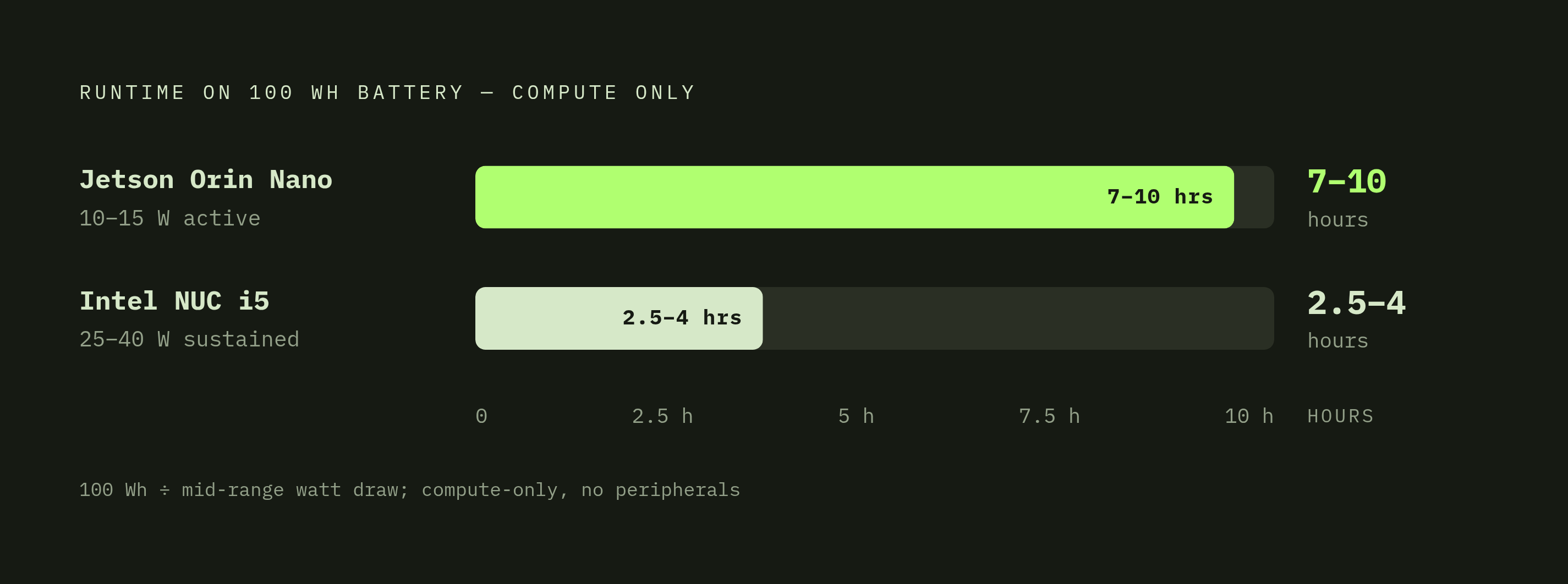
Power draw under real robot workloads is where the gap turns into something a battery budget actually feels. Jetson Orin Nano with active perception workloads running draws 10W to 15W. An Intel NUC running an i5 under sustained load draws 25W to 40W. Run the math on a 100Wh battery pack and Jetson yields roughly 7 to 10 hours of compute-only runtime, while the NUC yields roughly 2.5 to 4 hours. For a mobile robot, that means finishing a shift instead of stopping mid-task to recharge.
Software ecosystems: where each platform's real advantage and friction live
NVIDIA's software stack is deep, and it's specific to NVIDIA hardware. JetPack 6 ships Ubuntu 22.04 with CUDA 12, TensorRT, cuDNN, and VPI included out of the box, with DeepStream available as a separately installed, supported SDK on top. ROS 2 Humble runs natively, and Isaac ROS adds GPU-accelerated nodes for cuVSLAM, Nvblox 3D reconstruction, and image processing pipelines that lean on the same Tensor Cores doing the inference work.
TensorRT is optimized for NVIDIA hardware and delivers its full benefits on Jetson platforms. Isaac ROS is similarly oriented toward NVIDIA hardware, meaning teams working on Intel-only platforms will find limited compatibility. Models like DeepSeek, Qwen, Llama, and various vision-language models already ship pre-optimized for Orin, which cuts real setup time for teams building on that stack. The honest friction is that JetPack tends to lag behind upstream Ubuntu and ROS releases, the broader x86 ecosystem means more software assumes that architecture by default.
Intel's answer is OpenVINO, which optimizes models for Intel silicon targeting low-latency inference. Intel's Robotics AI Suite wraps that up with ROS 2-centric components, OpenVINO-optimized models, SLAM and navigation tutorials, humanoid imitation-learning pipelines, benchmarking tools, and reference applications covering things like wandering behavior, object detection, and floor segmentation. A newer piece, the OpenVINO Physical AI Framework, is scheduled for general availability in the second half of 2026; as of now, it's preview software living on GitHub, not a finished product.
Where x86 genuinely wins is friction, or the lack of it. Standard Ubuntu, Windows, or a real-time Linux kernel all run without any ARM porting step, and software that works on a developer's laptop tends to just work on the NUC too. That makes OpenVINO the clear pick for Windows-based factory PCs, retail cameras, and medical carts, environments where Intel CPUs already run the show and swapping architectures isn't worth the disruption.
The practical rule holds cleanly in both directions: TensorRT wins when the edge node is a Jetson, OpenVINO wins when the edge node is Intel silicon. The two paths aren't interchangeable, and picking a hardware platform means committing to one inference optimization stack over the other, not keeping both options open.
Form factor, thermal, and embedding constraints that spec sheets skip
Jetson's Nano and NX modules are system-on-modules, designed to sit on a custom or off-the-shelf carrier board rather than ship as a finished computer. That opens the door to deep chassis integration: custom I/O layouts, ruggedized enclosures, and mounting configurations a boxed mini PC simply can't offer. A carrier-board ecosystem has grown up around this, with partners including AAEON, ADLINK, Advantech, Aetina, Antmicro, Aptiv, Auvidea, AVerMedia, Connect Tech, Seeed Studio, and YUAN, among others, each building boards for different robot form factors and I/O needs.
The Nano's power envelope, 5W nominal with a 15W peak, is what makes it a real option for battery-powered, passively cooled enclosures. At 5W continuous draw, a modest LiPo pack keeps inference running for hours without a fan or a heat sink doing much heavy lifting.
Community stress testing on the Orin NX, reported on NVIDIA's developer forums, reveals thermal behavior under sustained load that spec sheets don't capture on their own. A configurable power ceiling describes a maximum, not how a specific enclosure, airflow design, or ambient temperature will actually behave once the board is sealed inside a robot chassis in the field. Anyone embedding these modules into a final product has to validate thermals in the actual enclosure.
Sources
- NVIDIA Corporation - NVIDIA Announces Jetson Orin Nano 2 Robotics Computer to Redefine Entry-Level Edge AI
- NVIDIA Jetson AGX Orin Developer Kit (64GB) Review: 275 TOPS in a 110m – ThinkRobotics.com
- NVIDIA Jetson Orin NX Module Review: Specs, Use Cases, Price, and How – ThinkRobotics.com
- NVIDIA Jetson Orin Nano Super Developer Kit Review: Is It the Best Edg – ThinkRobotics.com
- fictionlab.pl
- asus.com
- When Is NVIDIA Jetson Orin the Right Fit for Your Project?
- Getting Started with Edge AI on NVIDIA Jetson: LLMs, VLMs, and Foundation Models for Robotics | NVIDIA Technical Blog