Time-Sensitive Networking for Robot Ethernet Backbones
Deterministic delivery requires composing four distinct IEEE standards into one coordinated system.
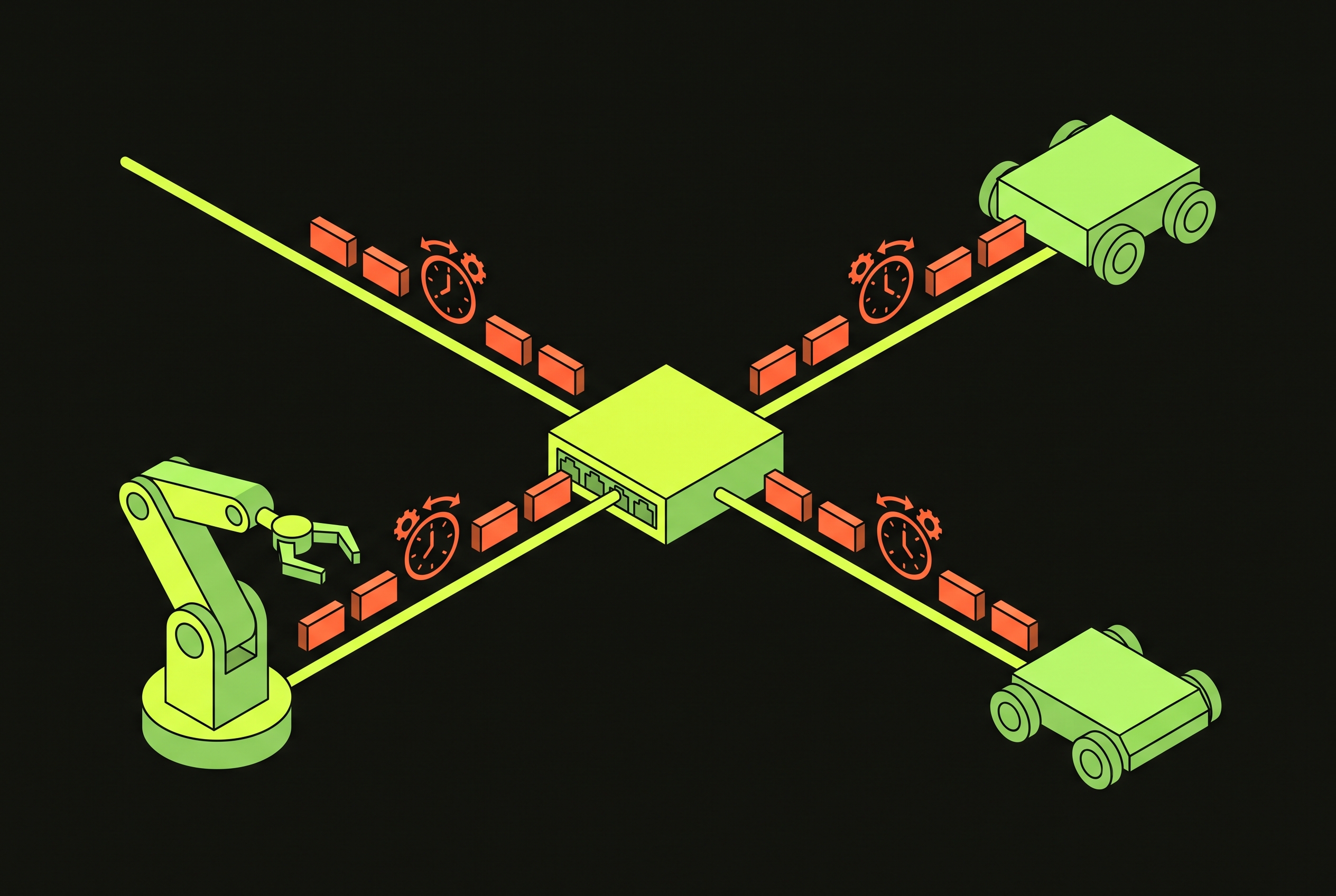
Time-Sensitive Networking for robot Ethernet backbones is an exercise in composing guarantees. Motor drives, sensors, and controllers all need their data to arrive on time. TSN turns best-effort Ethernet into a deterministic control fabric through shared time, scheduled transmission, frame preemption, and redundant delivery. Its practical value depends on configuring and validating those layers as one system.
Why standard Ethernet cannot meet robot backbone requirements
Standard Ethernet cannot reserve transmission time for periodic control traffic. Diagnostics, logging, and parameter updates can occupy the medium when a control frame needs it, creating variable latency and jitter. In closed-loop systems, that variation can slow communication, cause deadlines to be missed, and make control unstable. The limitation is structural, so tuning a best-effort network cannot replace a mechanism that governs access to transmission time.
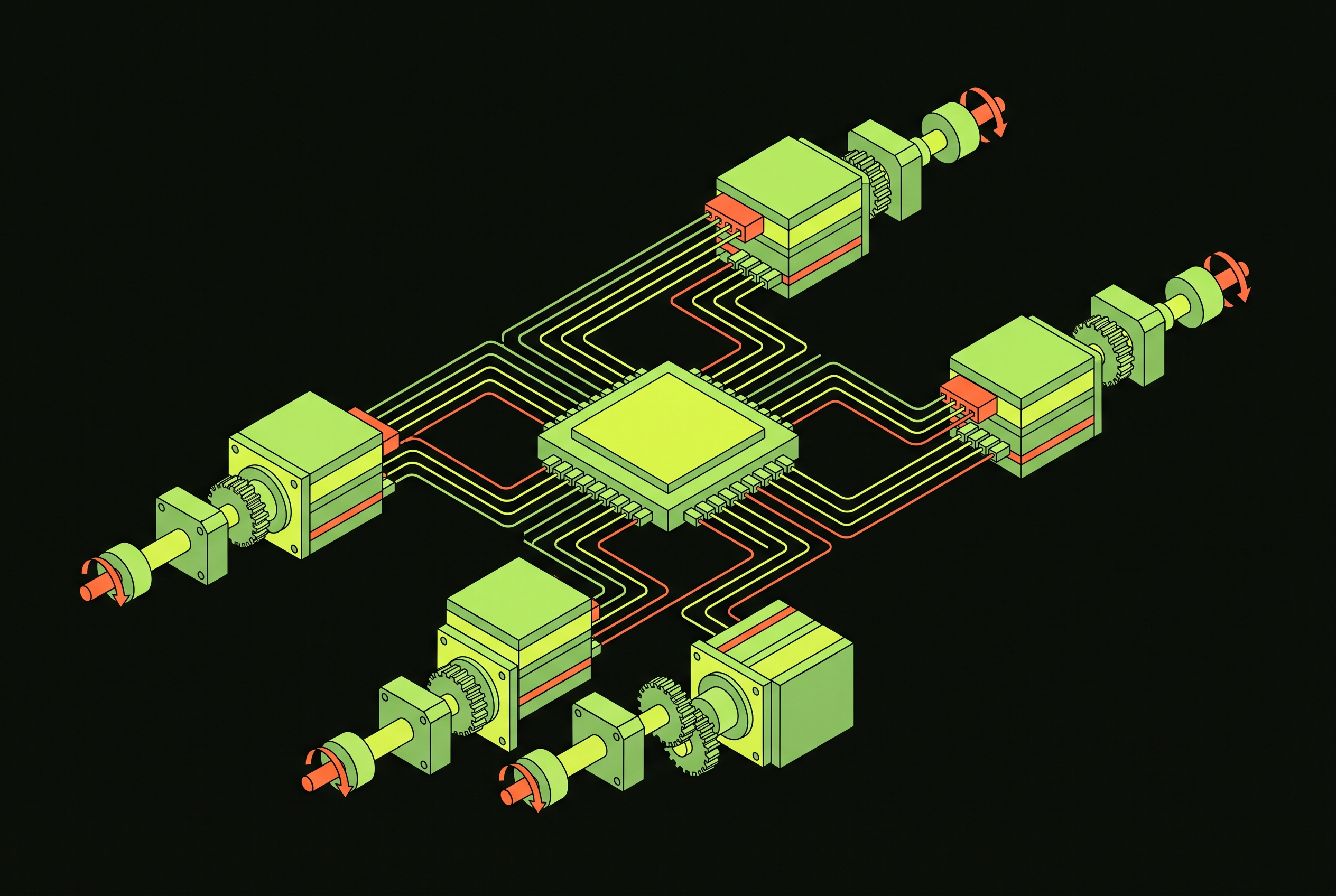
TI's AM261x application note treats the network as part of the control system itself. A humanoid robot must synchronize motor drives, IMUs, cameras, and tactile arrays for balance, locomotion, and manipulation. Design guidance for humanoid robots calls for over 100 Ethernet ports in one network that carries data from both low-speed sensors and multi-gigabit vision links. With that many ports, ad-hoc timing management cannot guarantee that data will arrive on time.
What the TSN standard suite is and why it is a layered composition rather than a single protocol
TSN is a collection of IEEE 802.1 standards, with complementary Ethernet mechanisms, rather than a single industrial communication protocol. Each part addresses a different requirement, and the deterministic result comes from their composition. The four load-bearing parts for this backbone architecture are IEEE 802.1AS (gPTP), IEEE 802.1Qbv (TAS), IEEE 802.1Qbu and IEEE 802.3br (frame preemption), and IEEE 802.1CB (FRER). They are distinct mechanisms with separate roles in obtaining the deterministic result.
That distinction changes how engineers assess TSN support. A device's support for one mechanism does not establish that it can fulfill every role in a deterministic backbone. Likewise, turning on several features on their own does not guarantee delivery from end to end. The practical engineering task is to understand their dependencies and make their configuration fit the topology and traffic.
How IEEE 802.1AS (gPTP) creates a shared time reference across all nodes
IEEE 802.1AS provides the common clock on which scheduled transmission depends. Without that reference, independent clock drift would make an absolute transmission window mean different things at different nodes. A schedule could then exist in every switch without being enforced consistently across the network.
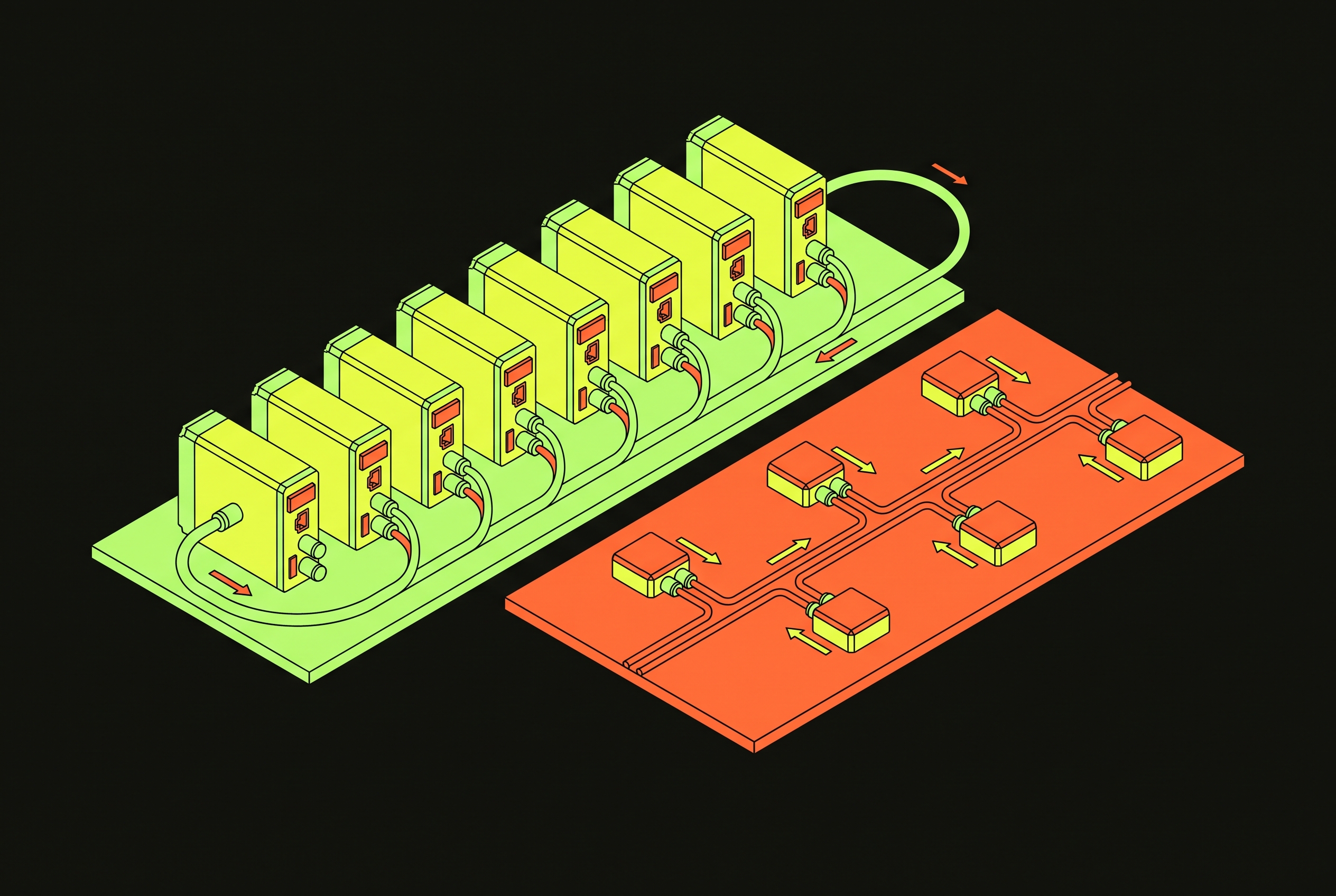
TI's AM261x application note describes synchronization across serially connected nodes in a daisy-chain backbone. Each device uses two Ethernet ports, one connected upstream and the other downstream. Reliability also requires redundant grandmaster clocks to maintain synchronization through operating events such as power fluctuations. Cumulative timing discrepancies can otherwise disrupt transfer through delays or packet loss that a closed-loop application cannot recover from at its own layer. Once the nodes share a stable time reference, that reference can govern when their queues transmit.
How IEEE 802.1Qbv (TAS) allocates transmission windows so control traffic cannot be crowded out
IEEE 802.1Qbv uses synchronized time to open and close per-queue transmission gates on a fixed schedule. Its time-aware shapers apply TDMA principles to allocate periodic slots for critical data, including motion control commands and safety signals. During those slots, lower-priority queues remain closed, preventing them from starting transmissions that compete with control traffic. Because the shapers share IEEE 802.1AS time, the windows form a coordinated schedule.
Engineers must create the gate schedule within traffic profiles for the robot so that each traffic class gets access in time to meet its deadline. Safety traffic places a further constraint on this design because interference must not push delivery toward the watchdog boundary.
Microchip's TSN/OPC UA white paper demonstrates TAS through industrial motor control sharing a network with video transfer. It shows the effect of enabling and disabling TSN features on latency, jitter, and bandwidth utilization. This mixed workload shows why scheduling matters even when Ethernet has enough capacity to carry all the traffic. But closing a queue does not stop a lower-priority frame that is already being sent.
How IEEE 802.1Qbu and 802.3br (frame preemption) reduce worst-case latency in long daisy chains
A large diagnostic frame can begin transmission just before a control window opens. Without frame preemption, the urgent frame must wait for that transmission to finish. IEEE 802.1Qbu specifies the preemption policy, while IEEE 802.3br defines the MAC Merge sublayer and the corresponding fragmentation and reassembly behavior. Together, they let high-priority traffic interrupt a lower-priority frame before the rest of that frame has been sent.
This residual blocking matters especially in a long daisy chain, where forwarding and processing delays accumulate at successive nodes. A large low-priority frame anywhere along the path can consume the margin needed to meet a motion control deadline. TI's AM261x application note identifies TAS, frame preemption, and cut-through switching as cooperating technologies for reducing worst-case latency. The CPSW peripheral's cut-through switching starts forwarding before the whole frame has arrived, so each hop avoids the serialization delay of a full frame.
The dependency is now explicit. gPTP establishes shared time, TAS assigns transmission windows, and frame preemption limits blocking at their boundaries. Preemption without scheduling can reduce latency, but it does not supply the complete timing guarantee. For long robot chains, it is essential to keeping the worst-case bound tight enough for servo-rate control cycles. These mechanisms address latency, but a separate layer must preserve delivery when a link fails.
How IEEE 802.1CB (FRER) provides redundancy without sacrificing determinism
IEEE 802.1CB provides Frame Replication and Elimination for Redundancy. It sends identical copies on independent paths, allowing the receiver to deliver the first arrival and discard the duplicate. If one path fails, the surviving copy maintains the control stream without requiring retransmission. Unlike spanning tree or RSTP recovery, this proactive approach does not wait for network reconfiguration after the fault.
But FRER needs another path, so a simple daisy chain must add a ring or partial mesh to give it that redundancy. Topology and FRER configuration are consequently coupled decisions. The four mechanisms can work as a backbone only when the chosen paths fit the timing architecture.
How the four TSN standards compose into a working robot backbone architecture
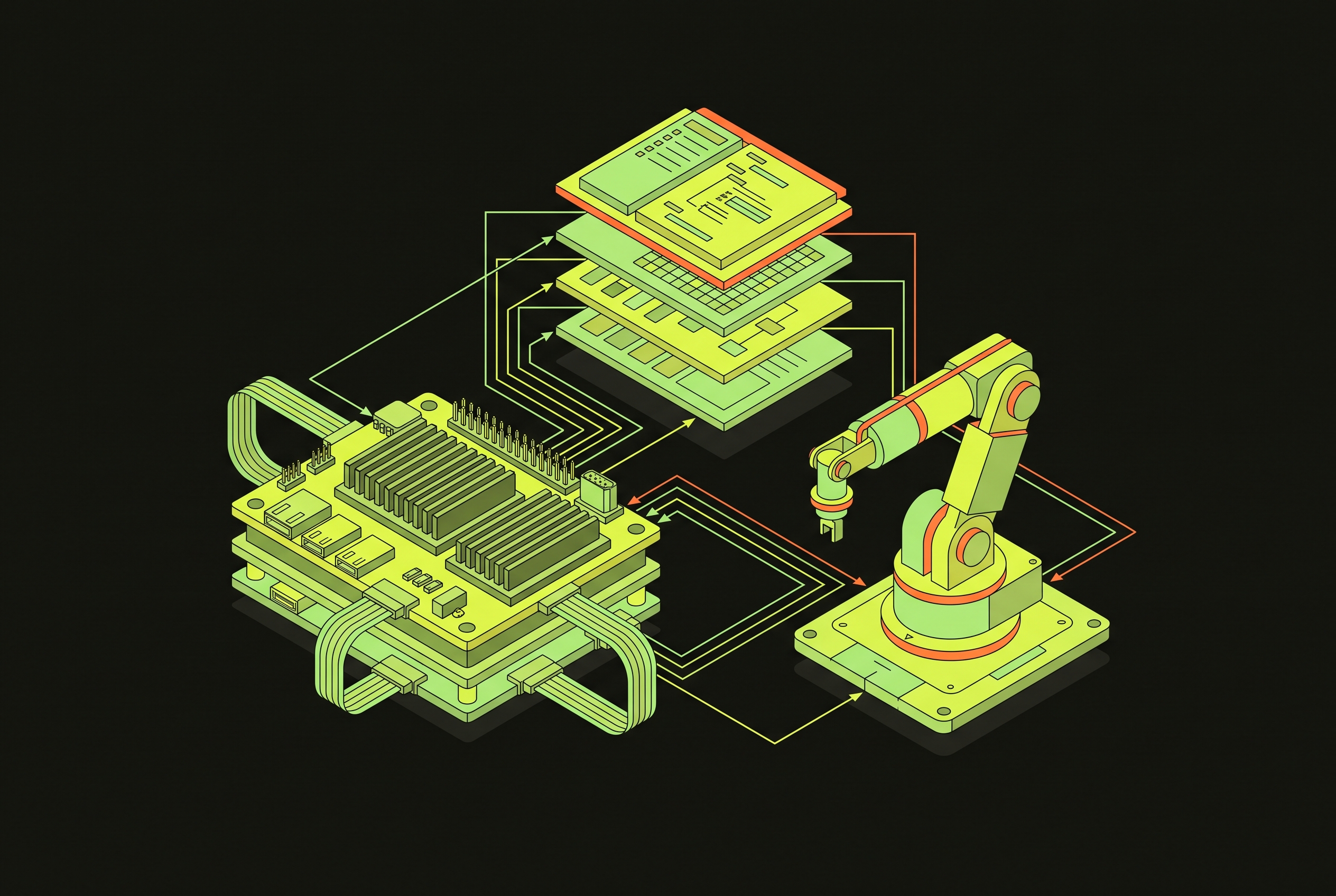
TI's AM261x application note shows an implementation in which AM261x-LP nodes are connected in series through the integrated CPSW 3-port Gigabit Ethernet switch. It operates gPTP, TAS, and frame preemption together. Links that connect each node straight to the next remove the need for centralized switches between them. That arrangement reduces cabling where a humanoid robot has little routing space and a tight weight budget.
The implementation illustrates the timing foundation, while FRER adds a separate requirement for redundant paths. Stable gPTP must precede enforcement of TAS windows, and preemption must fit those windows to bound blocking. FRER topology planning must also accompany schedule design.
Traffic classification connects these mechanisms to the robot's workload. A backbone typically separates safety/control traffic with the strictest deadlines, hard-real-time motion control commands, and best-effort diagnostics and logging. Each class needs scheduled access consistent with its requirements, based on an upfront model of the traffic streams. Microchip's PolarFire SoC FPGA illustrates a different hardware partition, with TSN functionality in FPGA fabric and software in the Microprocessor Subsystem. The architectural principle remains coordinated timing and traffic handling, regardless of where the functions reside.
Where semiconductor integration is reducing the hardware barrier to TSN deployment
Building TSN switching into processors and microcontrollers cuts the need for external components that used to take up more board area, add cost, and make the hardware bulkier. TI's AM261x combines its Ethernet switch with hardware support for gPTP, TAS, and frame preemption in a shipping device. Industrial processors with multiple Ethernet interfaces also enable redundant architectures and multiple deterministic streams without external switch silicon. Microchip's low-power PolarFire SoC FPGA shows that this integration trend extends beyond microcontroller-based designs.
Cabling is becoming more suitable for constrained robot interiors as well. Single Pair Ethernet with 1000BASE-T1 replaces the two or four pairs of standard Ethernet with one pair, reducing cable weight and diameter. SPESA's May 2026 white paper identifies SPE as the physical layer and TSN as the means of making humanoid in-robot networks deterministic. Higher-bandwidth vision and sensor-fusion links can extend the TSN framework to 10-Gigabit Ethernet. However, chip integration does not remove the ecosystem requirement for hardware timestamping at every participating node.
Practical challenges engineers face when configuring and validating a TSN backbone
TSN deployment requires explicit planning for configuration and validation, rather than treating adoption as installation of a single industrial Ethernet protocol. The TAS schedule must be tested against worst-case deadlines and revalidated when a sensor, drive, or diagnostic stream changes. Safety traffic must be shown to arrive within its watchdog boundary. These obligations do not have a direct equivalent in EtherCAT or Profinet IRT commissioning in the same form.
Multi-vendor operation adds another validation burden. Early deployments have exposed differences in IEEE 802.1Qbv and IEEE 802.1Qci implementations that require further testing and firmware updates. The Avnu Alliance drives interoperability testing and certification, but that infrastructure is still maturing. Validated schedule generation and TSN-aware commissioning tools are also not standard equipment in most OT engineering teams. Teams therefore need more skills in network engineering.
Engineers need to pay close attention to per-hop latency budgets in long daisy chains because less has been documented about their worst-case behavior in shipping implementations than about that of star configurations. TI's application note addresses expected debugging work, including topology verification, traffic-flow analysis, high-priority latency and jitter, PHY link management, and error handling. These are normal implementation concerns. They are tractable with suitable tooling, expertise, and validation time.
How TSN relates to OPC UA, Profinet over TSN, and EtherCAT in a mixed-protocol robot cell
TSN provides deterministic transport while leaving an industrial protocol's command model and diagnostic behavior in place. A scheduled backbone can carry EtherCAT tunneled through TSN frames, Profinet over TSN, OPC UA PubSub, and standard TCP/IP together. Their coexistence depends on bandwidth allocation rather than an assumption that different protocols cannot interfere. Safety certification paths and commissioning workflows remain responsibilities of the application-layer ecosystem.
OPC UA PubSub over TSN separates those responsibilities clearly. OPC UA supplies the data model and security layer, while TSN supplies deterministic delivery. Microchip demonstrates that combination with motor control and video transfer on PolarFire SoC. For PLC-centric brownfield factories, Profinet over TSN offers a pragmatic migration path that preserves engineering tooling and PLC integration. For greenfield robot platforms targeting cross-vendor integration, OPC UA PubSub over TSN is the forward-looking architecture.
That direction should not be confused with completed interoperability at scale. OPC UA Field eXchange, or UAFX, has published controller-to-controller specifications at v1.00.04, and Beckhoff hosted a prototyping interoperability event in February 2026. Controller-to-device specifications are still at the release-candidate and prototyping stage, and the conformance infrastructure is still being built. TSN is a foundation for cross-vendor real-time communication.
What engineers should assess when evaluating TSN for a robot backbone project
Engineers first check that the topology fits the robot's physical limits and has the alternative paths FRER needs. Daisy chains suit weight- and space-constrained designs, while stars suit cells that favor centralized management. Engineers next check whether every traffic stream fits the available bandwidth with margin. Control-cycle frequencies, safety watchdog intervals, vision frame rates, diagnostic polling rates, and worst-case frame sizes must be characterized before schedule authoring.
A hardware audit must establish whether every end device supports timestamping accurate enough for gPTP and TAS. Protocol selection must then match the intended cell, preserving existing Profinet or EtherCAT tooling where appropriate or supporting new cross-vendor integration through OPC UA PubSub. Validation planning must reserve explicit project phases for schedules, interoperability, and safety deadlines before integration.
The choice of platform also sets the board area, power budget, and BOM cost. TI AM261x represents the microcontroller-integrated path, Microchip PolarFire SoC provides an FPGA-based SoC approach, and CAST's TSN endpoint IP includes TSN-EP-10G for high-bandwidth vision links. Each choice fits different integration constraints, so no one choice is best for all designs. TSN's layered architecture is now available in shipping silicon, so engineers must determine how its configuration and validation will establish the required guarantees.
Sources
- Time-Sensitive Networking (TSN) for Industrial Automation ...
Supplied the industrial motor control and video transfer example used to illustrate TAS latency and jitter effects, and the OPC UA PubSub over TSN architecture on PolarFire SoC.
- Application Note Designing a Deterministic Scalable Ethernet Backbone for
Provided design guidance for the AM261x humanoid robot backbone, including daisy-chain topology, gPTP redundancy, frame preemption, cut-through switching, and debugging procedures referenced throughout the article.