FPGA-Based Motor Control for Low-Latency Robot Axes
Deterministic microsecond-scale control eliminates timing jitter across robot axes.
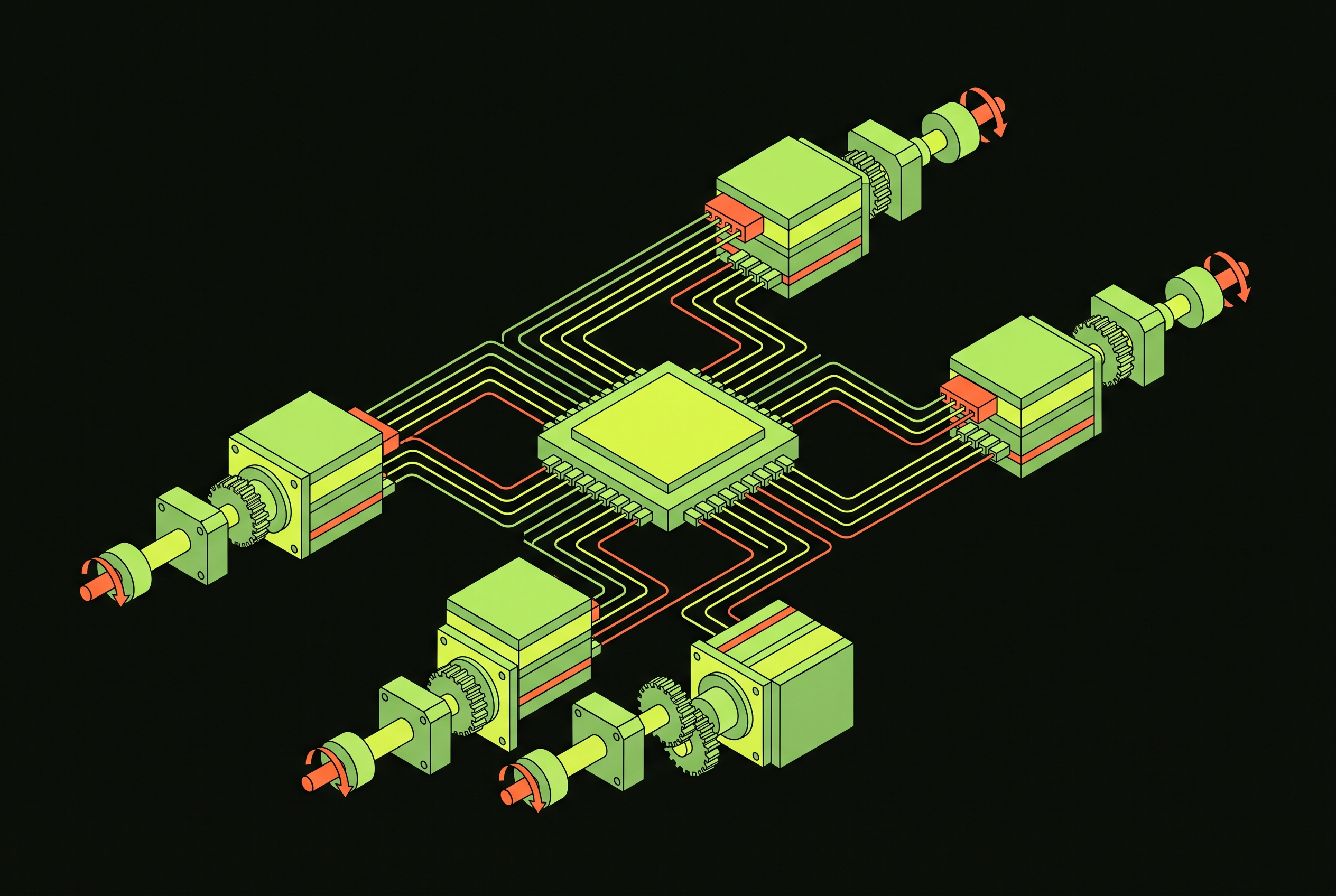
FPGA-based motor control solves a timing problem that software alone cannot fix: when control logic runs hardwired into silicon instead of through a processor's instruction scheduler, a robot axis gets the same response time on every cycle, measured in microseconds. That guarantee, not raw processing power, is what separates a six-axis arm that holds position under load from one that drifts, oscillates, or stalls out when the pace picks up.
Why CPU-Based Motor Control Loops Fail
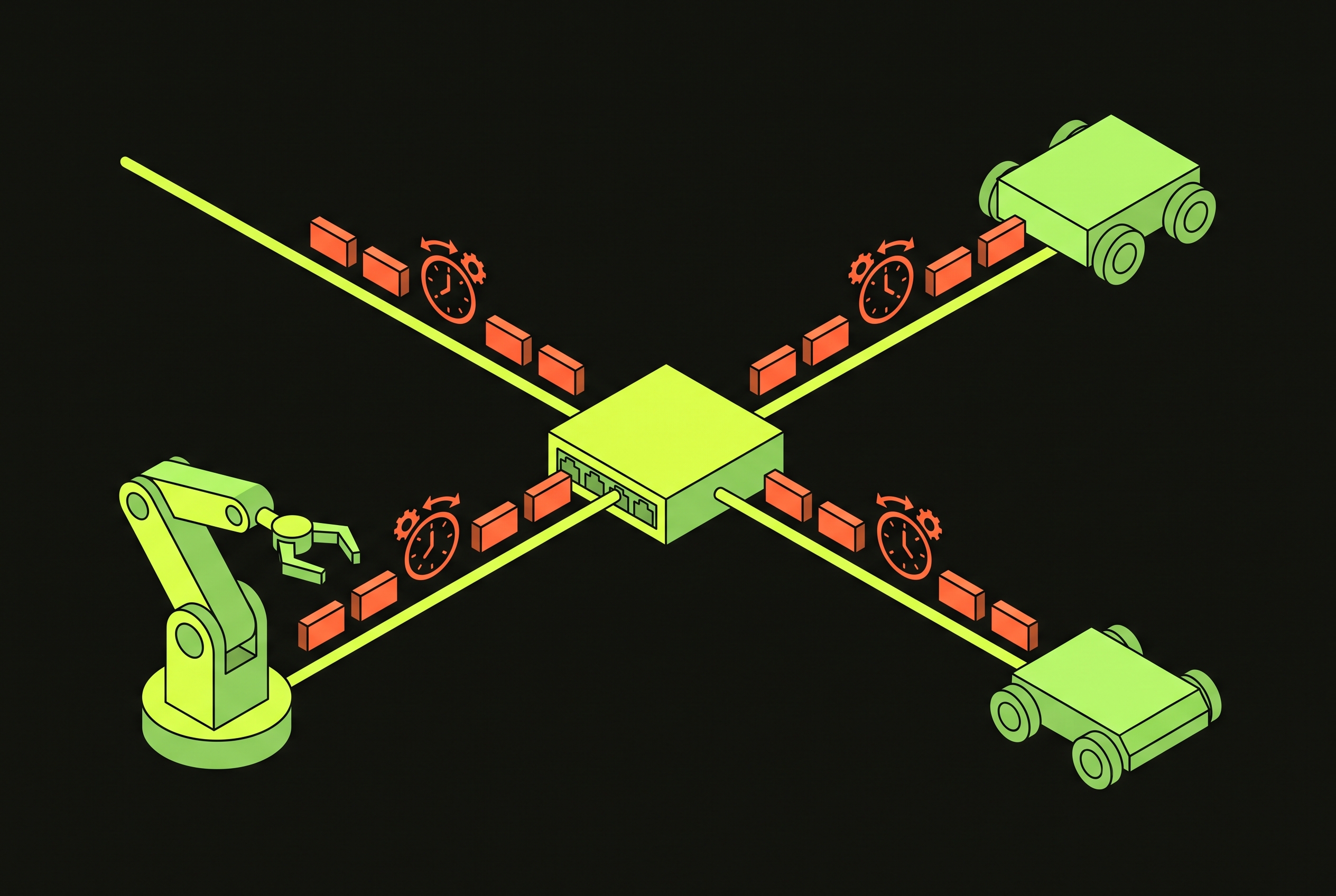
A general-purpose CPU running a motor control loop is a tenant, not an owner. The operating system can preempt it at any moment to hand cycles to another process, a network interrupt, a disk operation, or a dozen other tasks competing for the same core. That means the gap between a sensor reading arriving and the corrective PWM signal going out to the motor winding is not fixed. Jitter of this kind builds quietly at first and becomes serious once several axes depend on it simultaneously, because each axis adds its own unpredictable delay to a system that needs all of them synchronized.
The problem compounds sharply as axis count rises. What was tolerable sloppiness on one joint turns into a coordination failure once the OS is asked to schedule the same unpredictable gaps across many joints at the same time.
Missed target positions, motor instability, and, in safety-critical settings, collisions occur when this jitter compounds across axes. None of this arrives as a slow decline. The unpredictability comes from the architecture itself: an OS scheduler, a shared bus, and a processor built to serve many tasks at once, and no amount of software tuning removes this risk. The fix has to happen below the software layer, in the hardware that executes the loop.
How FPGA Hardware Execution Eliminates Timing Unpredictability
An FPGA solves the problem CPUs cannot by removing the scheduler from the equation. Control logic for a motor loop, in an FPGA, is not a program the chip fetches and executes. There is no operating system deciding when the loop gets its turn, no bus arbitration delaying a read or write, and no other process competing for the same execution window. The loop finishes when the hardware finishes, and the hardware finishes at the same point every cycle.
The architectural feature that makes this possible is parallelism. An FPGA doesn't execute one instruction after another the way a CPU does. Each function gets its own dedicated hardware path, because it doesn't share a single pipeline with everything else the system needs to do.
The arithmetic that motor control demands, PID loops, Kalman filters, matrix multiplications, runs on DSP slices built into the FPGA fabric itself, computing these functions directly in hardware rather than handing them off to a software stack that introduces its own delay. High-speed I/O support through protocols like PCIe, Ethernet, LVDS, and MIPI lets the FPGA talk to sensors and actuators without routing through intermediate chips, cutting out another source of delay. Edge AI processing, run through customizable fabric, sensor fusion logic, and dedicated internal RAM, lets decisions happen on the device itself. None of these features is incidental to the timing argument. Together they describe a chip built to guarantee behavior.
Measured Latency of FOC in FPGA Hardware
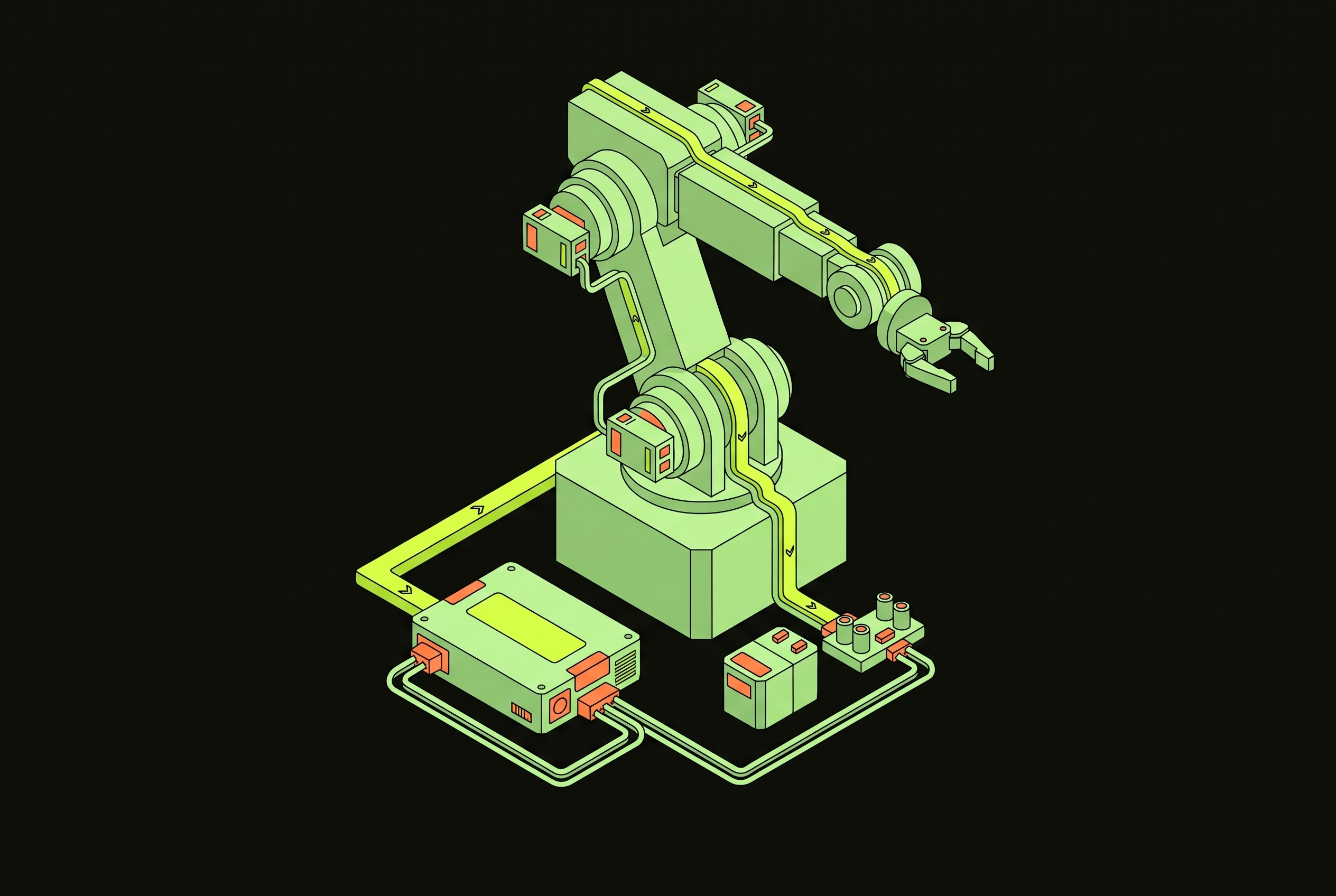
When you move Field-Oriented Control onto FPGA hardware, the gains aren't a matter of shaving a bit off an already-decent number. They represent a change in what a closed-loop system can do at all, taking feedback cycles that might run in milliseconds on a CPU down into the microsecond range. Field-Oriented Control manages motor torque by independently controlling the flux-producing and torque-producing components of current in real time, and because every other function in the loop depends on that torque calculation, it's the natural place to put the hardware advantage to work.
One documented FPGA design, built to specification for a customer running eight encoders, achieved a loop latency from ADC measurement to PWM output in the range of roughly 2 microseconds, and it did so while running above 200 MHz to satisfy external I/O requirements that included DDR and PCIe. That detail matters because the design still had to serve other demanding interfaces when it hit that result, so it wasn't achieved in a stripped-down test bench.
A 2025 ACM study on a force-feedback robotic arm measured a different but related layer of the stack. The study found that latency during data processing is a major barrier to reliable human-robot collaboration, and that when system delay grows, task completion time extends and path error grows with it. That relationship is what turns the 0.29 ms figure into a functional threshold for safe teleoperation rather than a number that simply looks good on a spec sheet. A force-feedback operator depends on the device accurately reflecting the torque the remote arm is experiencing in close to real time, and a system that calculates torque from measured currents quickly enough to map it to that device is what makes the collaboration trustworthy.
Three deployed systems that show FPGA motor control working across different robot classes
The case for FPGA-based motor control doesn't rest on laboratory benchmarks alone. Systems already running in the field, from warehouse robots to research humanoids, use FPGA hardware execution as the layer their motion control depends on.
Agiliad, in partnership with Lattice Semiconductor, built a custom autonomous mobile robot in 2025 for industrial settings and research labs, and it splits its control stack deliberately across three chips. The division is intentional: the deterministic motor and sensor work stays on the FPGAs, isolated from the non-deterministic ROS 2 layer, while the planning and mapping work, which can tolerate some variability, runs on the Jetson.
DFKI's RH5 humanoid, a 2-meter, 62.5 kg series-parallel hybrid robot capable of dynamic tasks with 5 kg payloads per hand, takes the decentralization further. Rather than routing every joint's control through one central processor, each actuator carries its own processing board built on a Xilinx Spartan 6 FPGA, running its local control loop independently at low latency. Each FPGA owns its own loop, so a 2-meter humanoid with many degrees of freedom doesn't inherit the coordination penalty a CPU-based system would face if it had to sequence all of them through one scheduler.
A four-degree-of-freedom robotic arm presented at the 2026 International Electronics Symposium rounds out the picture. Its FPGA-based motion controller generates synchronized control signals and performs kinematic computations in real time, and because it was presented at a mainstream conference, this shows this kind of control has moved past the research-curiosity stage and into standard engineering practice.
FPGA Acceleration from FOC to Model Predictive Control
Until recently, engineers choosing a control approach faced a genuine fork: fast control methods like PID and FOC could run in real time, but Model Predictive Control, which optimizes over a future time horizon while respecting physical constraints, was usually too computationally expensive to run onboard at the rates agile robot dynamics demand. FPGA acceleration is closing that gap, and a 2026 result from Columbia and Barnard researchers Andrea Grillo and Brian Plancher shows how far it's gone.
Their system, AccelMPC, runs onboard constrained MPC at 1 kHz on a Crazyflie quadrotor, handling dynamic obstacles at a rate that resource-constrained embedded platforms simply couldn't reach before. Solve times came in substantially faster than state-of-the-art embedded microcontroller-based solvers, and the improvement in energy-delay product over those solvers was larger still, a sign that the gain isn't just raw speed but computational efficiency per watt. The design scaled to optimization problems with more than 20,000 optimization variables, which rules out any suggestion that the result only works for toy-scale MPC formulations. The team released the PCB design files, firmware, and FPGA solver code openly, lowering the barrier for other labs to reproduce or build on the work.
What this means for the argument as a whole: the same deterministic silicon that guarantees a microsecond FOC loop can now run predictive, constraint-aware trajectory optimization as an onboard real-time loop, not a separate high-level process running somewhere else in the stack. That said, the AccelMPC authors flag an open caution as future work. The current implementation uses fixed-point arithmetic, and tightly pipelined fixed-point computation carries rounding error that can affect torque accuracy and constraint satisfaction. Before a result like this is ready for safety-critical deployment, you still need formal, systematic analysis of that precision effect. The frontier is confirmed. It isn't yet fully hardened for production.
Where FPGAs Are the Right Choice
None of this makes FPGAs the right answer everywhere. The FPGA advantage holds, but it holds under specific conditions, not as a blanket upgrade.
FPGAs earn their cost and complexity when a system needs many simultaneous axes that a single CPU cannot sequence deterministically, when closed-loop requirements fall under roughly 2 microseconds and even a real-time OS introduces too much jitter to tolerate, or when sensor fusion has to sit on the same chip as motor control so it avoids the latency of talking across separate chips. Microchip's documentation on this class of application notes that robustness, radiation immunity, and anti-tamper security have to hold alongside determinism, and it lists non-volatile flash memory as a product feature that supports that reliability, not as a standalone safety requirement.
The costs are physical as well as financial. A paper on FPGA design challenges notes that FPGAs run larger, draw more power, and cost substantially more than microcontrollers, and that engineers have to specify their own I/O pin assignments instead of relying on the dedicated fixed pins a microcontroller provides. The design burden lands at every layer of the project, not just the budget line.
High-Level Synthesis tools ease some of that burden, but they have limits. Microchip's SmartHLS compiles C++ directly to Verilog targeting PolarFire FPGAs, and it's the route by which the eight-encoder design reached its roughly 2 microsecond result. Teams should check HLS output against manually written RTL on any path where the timing is critical, rather than assuming the synthesis tool will match what an experienced RTL engineer would produce by hand.
GPUs mark the other edge of this trade-off. TurboMPC, a 2026 result from Gabriel Bravo-Palacios, Jianghan Zhang, Zachary Pestrikov, Brian Plancher, and Thomas Lew, is a fast, scalable, differentiable MPC solver built for GPU hardware, and it shows GPUs are a credible option for the planning and optimization layers of robot control. GPUs don't replace FPGA determinism down at the motor-current-loop level, but they do compete at the MPC and trajectory optimization layers, where the FPGA's advantage is less clear-cut.
The hybrid SoC architecture that is becoming the practical standard
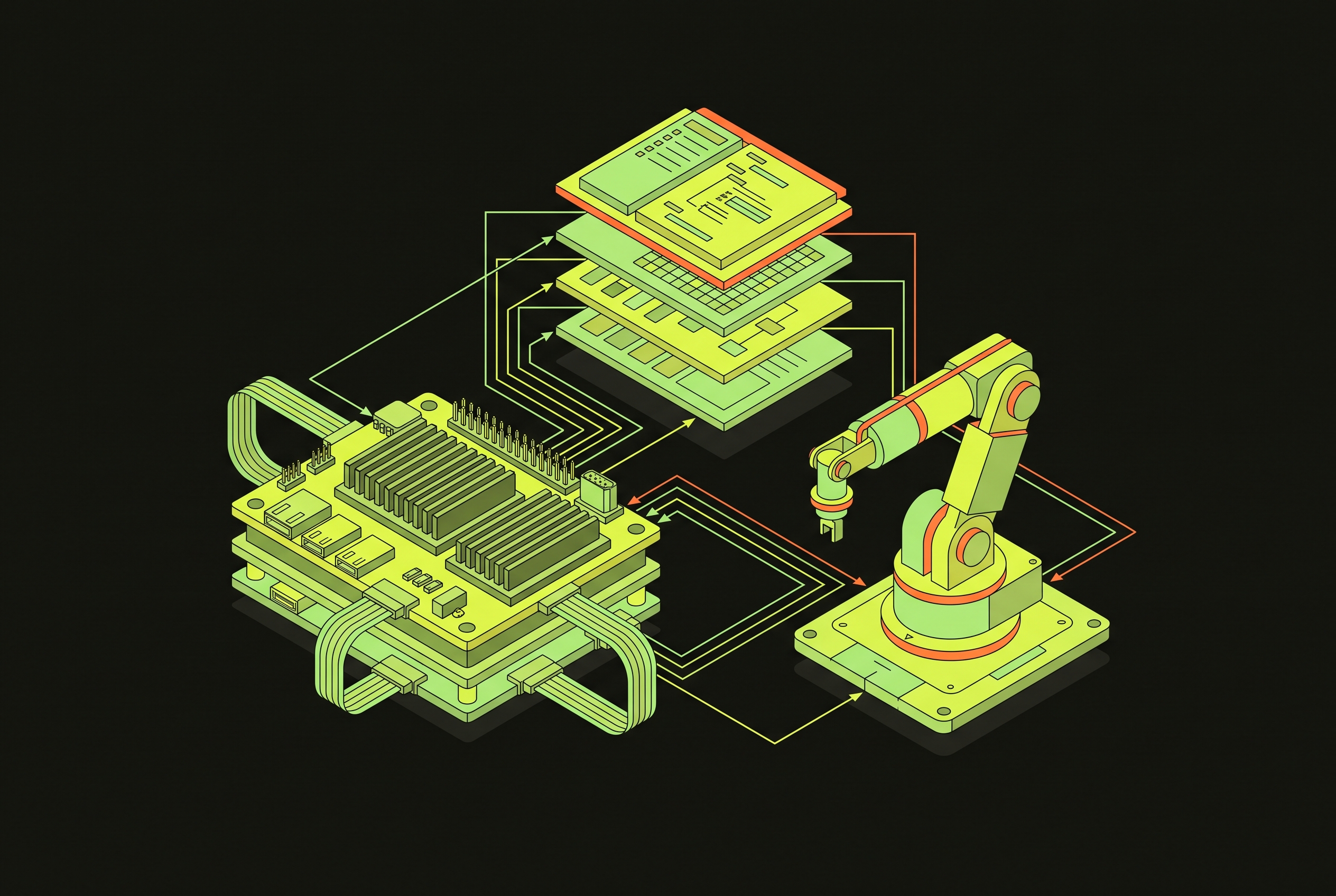
The practical consensus forming across these systems treats FPGAs, CPUs, and GPUs as complementary choices, each suited to different parts of the job. It couples a low-power FPGA tightly to a SoC or GPU, and it assigns each layer of the control stack to whichever hardware fits its timing requirements.
The Agiliad AMR is the clearest working example. The Certus-NX FPGA owns the deterministic PI motor control loops, encoder feedback, and PWM generation. The NVIDIA Jetson Orin owns ROS 2 SLAM, path planning (SMAC handling global routing, MPPI handling local trajectory optimization), and the higher-level navigation decisions. Communication between the Jetson and the Certus-NX runs over UART serial, passing motor velocity commands in real time across a narrow, well-defined boundary.
Another embedded motor-control board shows the same split, but at a smaller scale. The system supports up to four motors, both BLDC and brushed DC types.
Latency requirements, not raw processing power, decide which chip owns which function in both examples. Any loop with a microsecond deadline, current sensing, PWM generation, encoder reading, belongs on the FPGA. Any loop that can tolerate millisecond-range latency and benefits from algorithmic flexibility, SLAM, MPC, path planning, runs on the SoC or GPU instead. The interface between the two stays narrow and well-defined, and the FPGA doesn't become a pass-through for data that belongs on the SoC. This is what resolves the trade-off discussion from the previous section in practice: a team gets FPGA-grade determinism exactly where it's non-negotiable, without paying that architecture's full cost and complexity across the whole system.
Open-source hardware and maturing toolchains for FPGA motor controllers
The most persistent objection to FPGA-based motor control was never about whether it performed well. Each of those barriers is narrowing now, through a combination of HLS tools, open hardware releases, and modular IP ecosystems.
HLS is the clearest bridge. Microchip's SmartHLS lets an engineer who already has a working motor controller written in C or C++ compile it directly to Verilog targeting a PolarFire FPGA, with Microchip's own documentation citing up to a 5x reduction in development time compared to hand-coding RTL. The workflow in practice involves marking the top-level C++ function, using HLS pragmas and library calls to describe AXI, AXI-stream, or memory interfaces, and letting the tool generate the hardware IP core from there. The limitation from the previous section still applies here: HLS output needs validation against manual RTL on critical paths, because the performance gap between the two hasn't fully closed.
Open hardware releases are doing their own work to widen access. The PI control loop IP running inside the Agiliad AMR's Certus-NX is a working example of exactly that approach in production.
FPGA-based motor control is shifting from a specialist discipline that demands deep RTL fluency toward an engineering practice that teams with ordinary C and C++ backgrounds and standard embedded tooling can take on directly. The underlying silicon determinism hasn't changed, and the performance ceiling that makes this approach worth adopting in the first place hasn't dropped either. What's changed is the toolchain standing between an engineer's working code and the hardware that runs it at microsecond speed.
Sources
- ROS 2-Integrated Low-Latency Remote Force Feedback System Using FPGA-Accelerated FOC Control and Inverse Kinematics
Provided the 0.29 ms latency figure and the finding that system delay affects task completion time and path error in human-robot collaboration with FPGA-accelerated FOC.
- Design, analysis and control of the series-parallel hybrid RH5 humanoid robot
Provided the physical specifications of the RH5 humanoid robot and the detail that each actuator uses a Xilinx Spartan 6 FPGA for local control.
- AccelMPC: High-Rate, Low-Power FPGA-Accelerated Model Predictive Control for Tiny Drones
Provided the AccelMPC results including 1 kHz onboard MPC, solve-time comparisons, the 20,000-variable scaling figure, and the open release of PCB design files and FPGA solver code.
- Design Challenges for Robots in Industrial Applications
Provided the design-challenge details that FPGAs run larger, draw more power, and cost more than microcontrollers, and require manual I/O pin assignment.