EtherCAT vs CAN Bus for Robot Motion Networks
EtherCAT synchronizes axes to the microsecond; CAN trades precision for cost and simplicity.
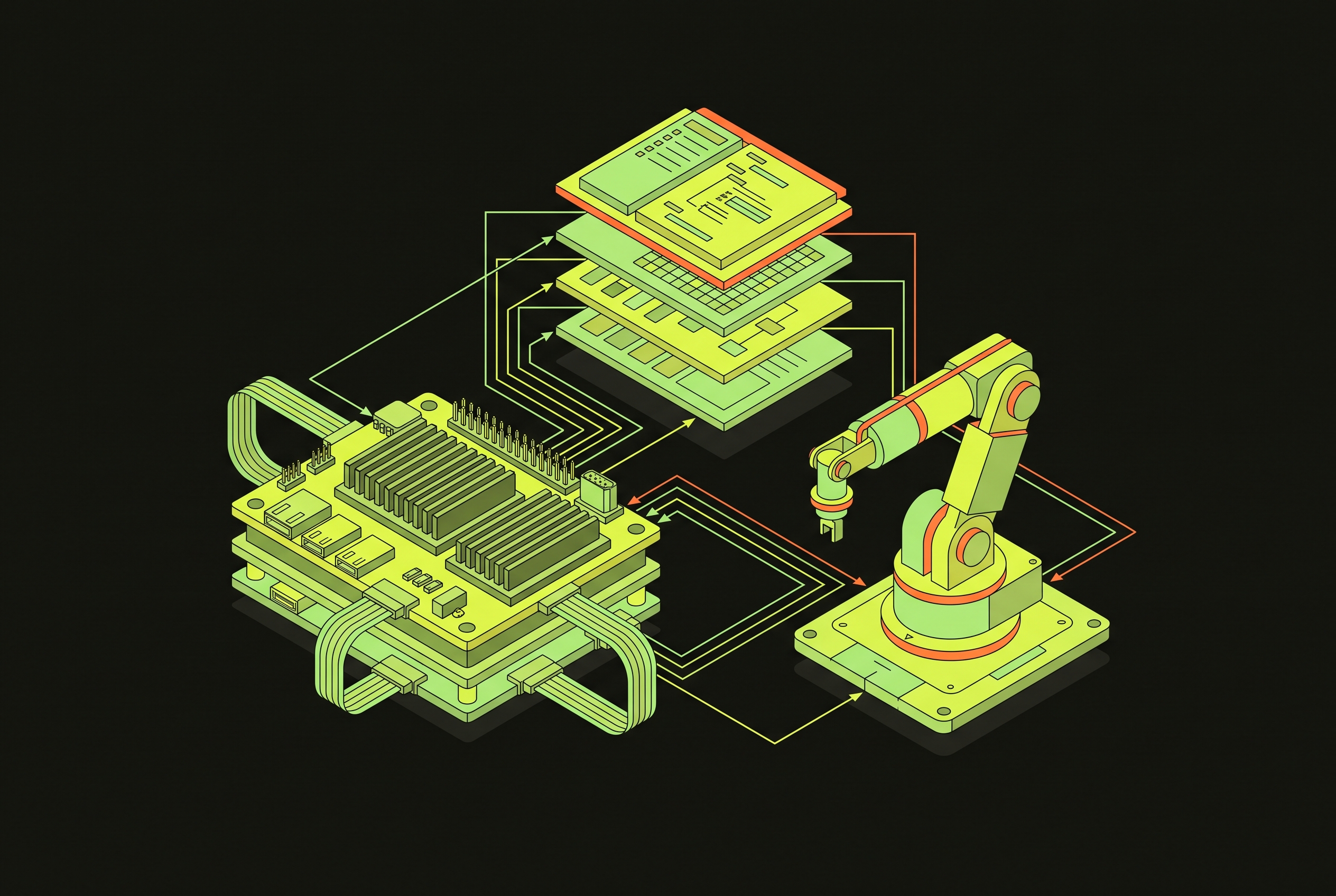
Engineers who argue over EtherCAT versus CAN bus usually end up talking past each other, because the two protocols were never built to solve the same problem. EtherCAT exists to make many axes move in lockstep with sub-microsecond timing. CAN bus moves messages reliably across a noisy, cost-constrained network, and it doesn't need a shared clock to do it. Treating them as interchangeable options on a feature chart, where one simply scores higher, produces the wrong network for the robot being built.
Machine architecture determines the EtherCAT vs CAN bus choice
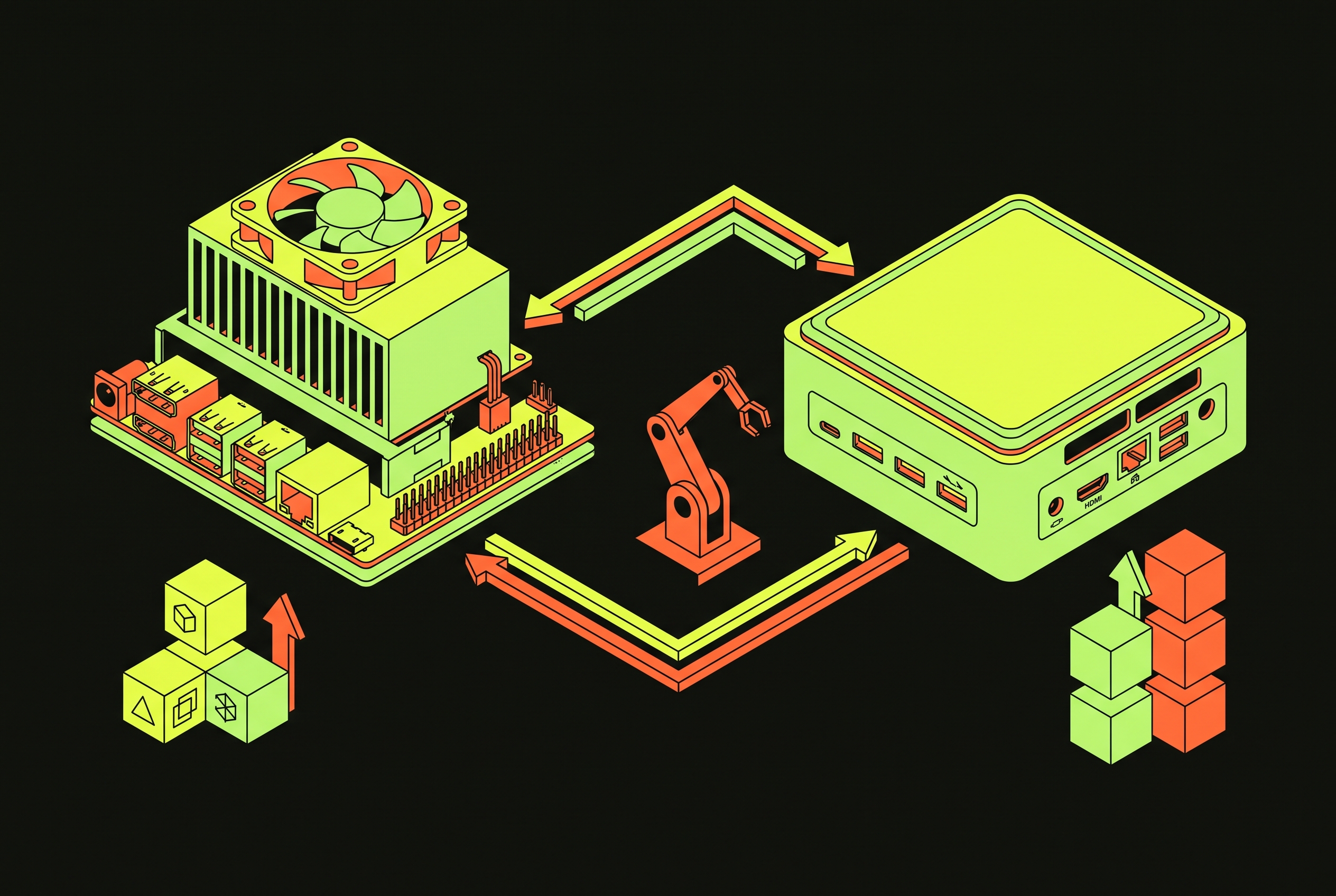
Ask ten robotics engineers whether EtherCAT beats CAN bus and you'll get ten different answers, most of them hedged, because the honest answer depends on what the machine needs to do, not on which protocol has the bigger number on its spec sheet. That frustration is a signal, not a failure of the question. EtherCAt was built around a single governing idea: get a bit to every node in the network at a known, shared instant, so that dozens of joints can be commanded as one coordinated system. CAN bus was built around a different idea entirely: let many independent nodes share a simple two-wire bus, survive electrical noise that would knock out more delicate signaling, and keep wiring and part costs low. Those are two different answers to two different constraints, not two solutions competing for the same job, and a robot's architecture should be built around whichever constraint it actually runs into first. Elmo's own comparison guide frames the decision the same way: it organizes the choice around performance tier and application requirements. The practical work of choosing a network starts with figuring out which ceiling your machine will hit, not with picking the protocol that wins more categories on paper.
The physical and data-link commitments of each protocol
The philosophical difference between these two protocols is backed by physical and data-link decisions that cannot be tuned away later, so it helps to lay them out side by side.
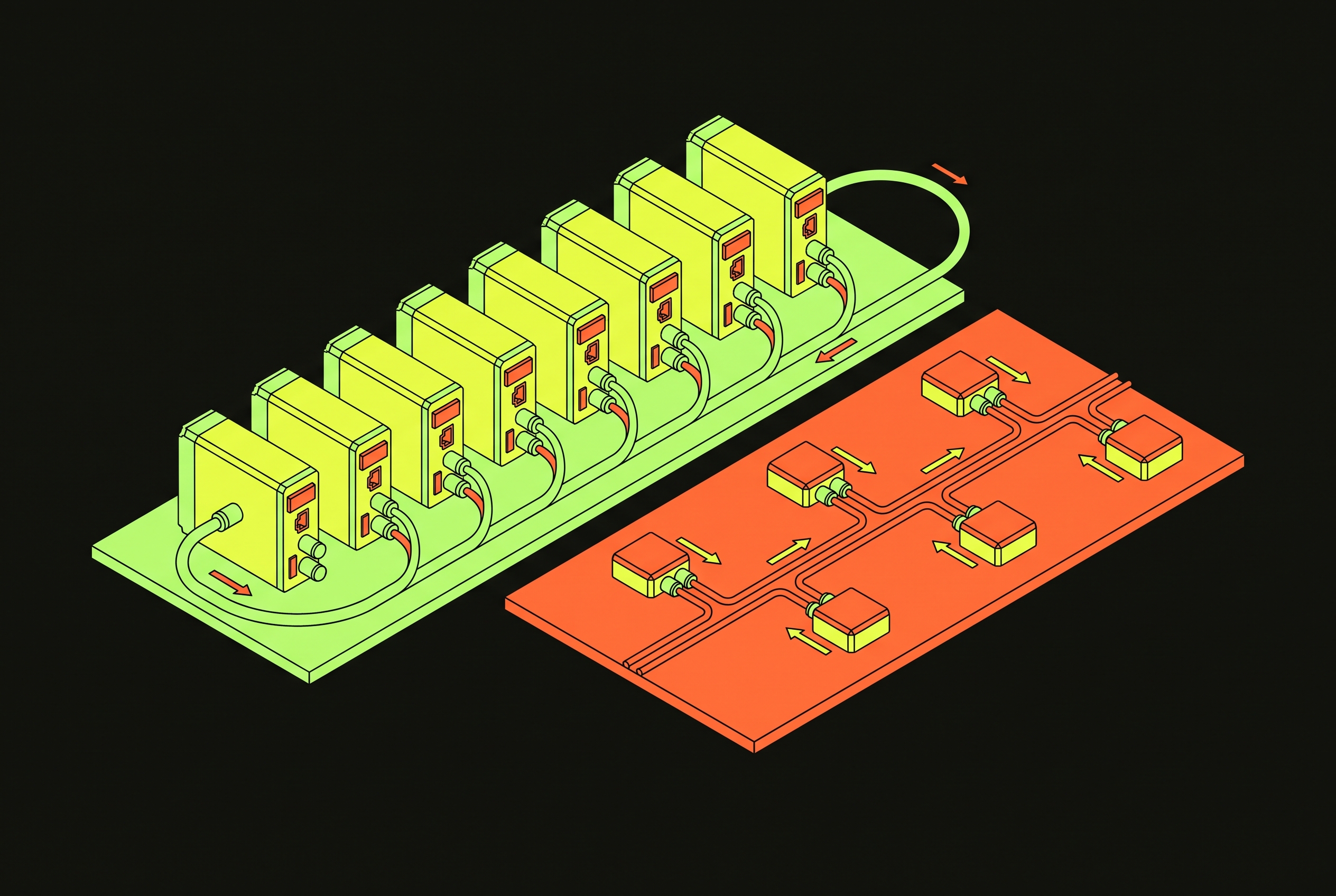
CAN and CANopen run on a differential two-wire bus. Classical CAN tops out at a maximum data rate of 1 Mbit/s, and each frame carries at most 8 bytes of payload. CAN FD loosens that ceiling: it extends the data field to 64 bytes and allows a faster data phase, but it keeps CAN's arbitration scheme intact. CAN uses non-destructive bitwise arbitration by message ID, so higher-priority frames always win the bus without corrupting the lower-priority frames they beat out. But the bus is still shared, and worst-case latency depends on bus load and how carefully message priorities were planned ahead of time. CANopen's node addressing uses a 7-bit node ID, so a single network is capped well below two hundred devices. If you push past that limit, you need multiple networks tied together with gateways, which increases complexity. Topologically, CAN is a linear bus: every device taps into the same two wires, in sequence. On top of that physical layer, CANopen defines an application layer built from an object dictionary, PDOs for cyclic real-time data, SDOs for configuration traffic, SYNC objects for coordinating simultaneous actions across nodes, NMT for managing device state, and the CiA 402 motion profile that standardizes how drives talk to controllers.
EtherCAT runs on standard 100BASE-TX Ethernet, giving it a maximum data rate of 100 Mbit/s, a full two orders of magnitude above classical CAN. What makes EtherCAT distinctive isn't just that higher bit rate, though, but a mechanism called processing on the fly: the master sends a single frame through the network, and each slave reads its output data and writes its input data as the frame physically passes through the device, without waiting for the full packet to arrive and without being re-transmitted hop by hop. Because of that mechanism, EtherCAT's latency stays low even as node counts climb. Layered on top of that is Distributed Clocks, a decentralized mechanism that synchronizes the local clocks on every slave device against a shared time reference. Elmo describes this synchronization as sub-microsecond, and the EtherCAT Technology Group's own materials describe it as substantially better than one microsecond. EtherCAT also supports far more logical addresses per segment than CAN does, and performance doesn't degrade as devices are added. Its topology is flexible: line, tree, star, or ring, with ring topology enabling network redundancy, and Elmo lists hot-connect and ring redundancy among the protocol's standard platform features. EtherCAT is standardized under IEC 61158 and the ETG's own standards, and it can tunnel IT protocols like TCP/IP through a mailbox channel without disturbing real-time data flow, but that TCP/IP traffic can't run natively alongside real-time traffic on the same wire at the same time.
CAN FD and the newer CAN XL represent the CAN ecosystem's response to rising data demands, each extending the standard in different ways. CAN FD meaningfully improves payload size and data-phase throughput, but it does not add anything like EtherCAT's distributed-clock synchronization, and arbitration on the bus remains shared among all nodes. CAN XL further extends payload capacity and throughput, and it even enables the tunneling of Ethernet frames. Both show that CAN's lineage is evolving to handle more data while deliberately preserving the robustness and low system cost that made CAN valuable from the start.
Cycle time and synchronization in motion control
The gap between these two protocols that actually bites in motion control is cycle time and synchronization quality, not the 100 Mbit/s versus 1 Mbit/s headline figure, and the two are closely related. Elmo's guide lists EtherCAT operating in the 50 to 250 microsecond range for typical cycle times, against CANopen cycle times that run substantially higher. That gap compounds directly into control performance: Elmo's guide states that shorter cycle times, comparing 250 microseconds to 1 millisecond, increase control loop update rates enough to reduce following error by 5 to 10 times and enable single-digit micrometer positioning that slower fieldbus protocols cannot reach.
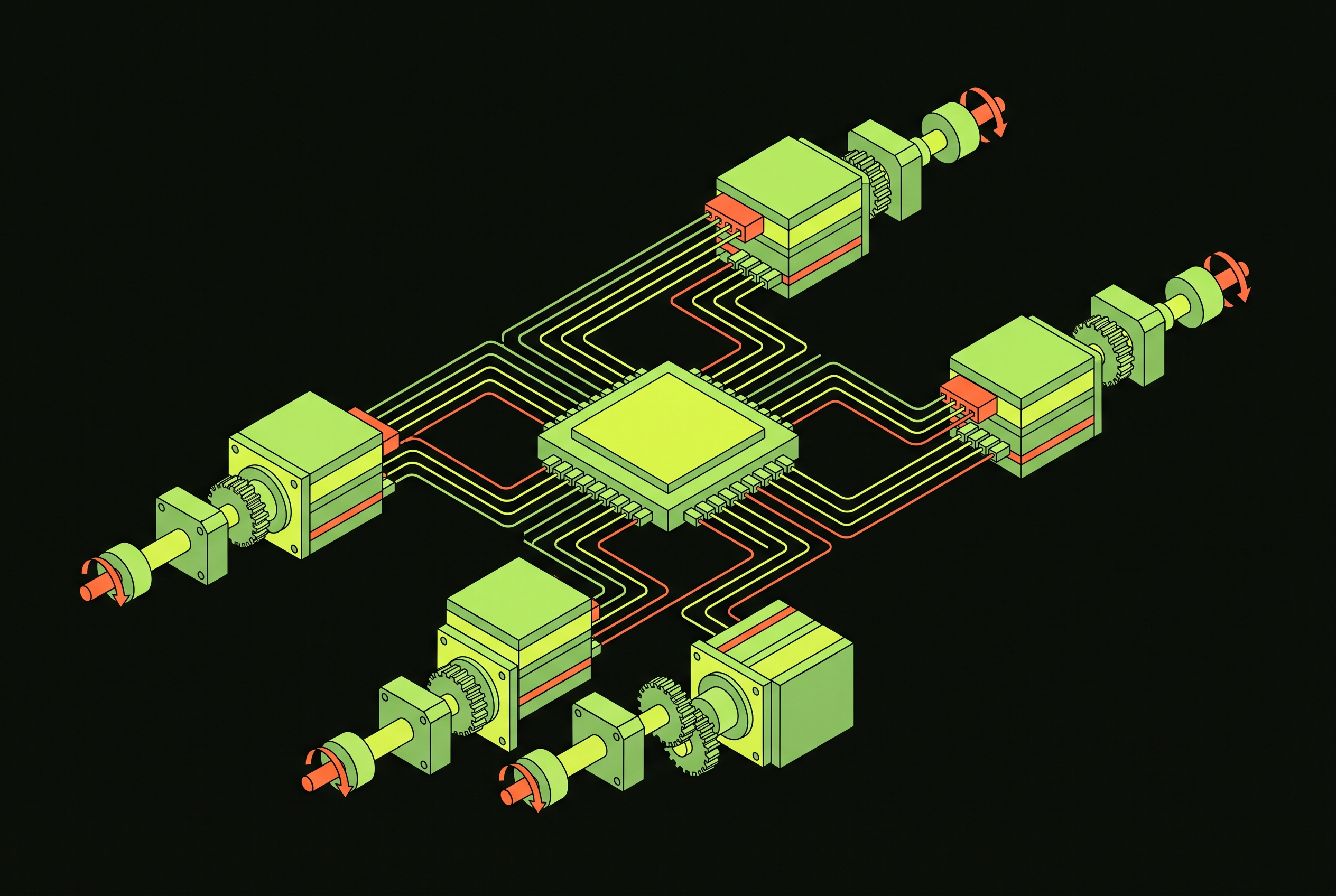
Synchronization quality is the deeper half of that story. EtherCAT's Distributed Clocks give every node on the network a shared time base, so feedback gets sampled and commands get applied at the same instant across the entire system. CAN's SYNC objects do coordinate simultaneous actions across nodes, but that coordination's quality depends on how loaded the bus happens to be at a given moment. It isn't architecturally guaranteed down to the microsecond the way EtherCAT's is. That distinction matters most in multi-axis machines, where timing error that would be invisible on a single-axis bench test turns into a real control problem once several axes have to move together: a few tens of microseconds of variation across joints can raise a visible error in whole-body control, dynamic walking, or compliant manipulation. In those systems, the communication bus is not sitting quietly in the background: it is functioning as a working part of the control loop itself, because the controller's assumptions about simultaneity depend on it.
CAN's scaling behavior makes the problem worse as a network grows, independent of its raw bit rate. As more devices join a CAN bus, arbitration contention rises, worst-case cycle time stretches out, and the network runs into a structural ceiling that has nothing to do with the 1 Mbit/s number on the spec sheet. Honpine's technical comparison of EtherCAT and CAN for harmonic drive motors makes the same point from the application side: CAN's cycle time can fluctuate because of how complex the communication content is and how uniform packet transmission ends up being, and the CSMA/CD collision mechanism means collision risk climbs as device count rises, a real synchronization risk for coordinating multiple harmonic drive motors at once. So you shouldn't ask which protocol moves more bits per second. It's whether the application needs a guaranteed shared instant in time across its axes, because that requirement, not peak bandwidth, is what decides whether EtherCAT's architecture is doing something CAN structurally cannot.
CAN bus as the right architecture: axis count, cost, and distributed intelligence
None of this makes CAN bus a lesser choice for the machines it fits. In that zone, CAN is the correct engineering choice, not a compromise standing in for something better.
The case for CAN gets stronger when you build around distributed intelligence. If each joint runs its own closed-loop controller locally and the network only needs to carry high-level targets back and forth, the bandwidth the bus needs to deliver shrinks a great deal. CAN FD's 64-byte payload and faster data phase handle that pattern comfortably, and the resulting architecture gets simpler, not more constrained, by choosing CAN. The protocol also brings advantages that have nothing to do with cost-cutting: differential signaling gives it strong resistance to electrical noise, the transceiver and microcontroller ecosystem around it is mature and well understood, its error handling is standardized down to fault confinement (a faulty node drops into a bus-off state instead of continuously disrupting the rest of the network), wiring costs stay moderate, and troubleshooting a CAN network is a well-worn skill across the industry.
That profile lines up with a specific set of machines: AGV and AMR drive systems, battery management units, steering modules, collaborative robots with a moderate number of axes, mobile machines generally, educational robots, and cost-sensitive humanoid designs where the compute for each joint lives locally rather than being coordinated from a central controller. CAN FD sits as an honest middle step in this landscape: it improves payload size and data-phase throughput over classical CAN, cuts down the number of messages needed when joint data gets richer, and keeps all of CAN's robustness and fault-handling behavior intact. For a design that has outgrown classical CAN's 8-byte payload but doesn't need EtherCAT-level synchronization, CAN FD is the right next step.
CAN also holds onto a field-deployment advantage that's easy to overlook. Elmo and other technical sources note that upgrading firmware on EtherCAT slave devices can be hard, since some devices offer limited protocol support; Elmo addresses this on its own hardware through FoE, or File over EtherCAT, which lets you update firmware over the network without falling back to a CAN bus or serial port connection. Where that FoE support isn't present on a given EtherCAT device, CAN's established field-update practices remain a real operational edge for systems that need to be serviced after deployment.
EtherCAT as necessary: high axis counts, synchronized whole-body control, and platform scalability
The case for EtherCAT shifts from better performance to what's architecturally possible once a platform crosses certain thresholds. A humanoid robot rarely stays at the scale it started at. A prototype with a handful of actuators grows into a network carrying lower-body joints, upper-body joints, hands, inertial sensors, force sensors, safety I/O, and assorted auxiliary modules. The cumulative demand for synchronized cyclic data across all of those nodes outgrows what CAN FD can deliver without splitting the network into segments joined by gateways, and gateways add exactly the latency and complexity a whole-body controller can't afford.
The strongest argument for EtherCAT at this scale comes from kinematic coupling. Hip torque affects trunk stability. Ankle timing affects foot placement. Shoulder motion can compensate for disturbances in gait dynamics. A whole-body controller needs one coherent snapshot of the entire body's state at a given instant, not a patchwork of readings taken a few tens or hundreds of microseconds apart from different nodes on the network. That's precisely what Distributed Clocks are built to guarantee, and it's not something CAN's SYNC objects can promise once bus load climbs.
EtherCAT's scaling behavior also protects the platform's architecture over time. EtherCAT supports far more logical addresses per segment without performance degrading, so the same network backbone that serves a 12-axis robotic arm can also serve a 50 degree-of-freedom humanoid without redesign. Honpine's comparison identifies EtherCAT-based harmonic drive motors as the mainstream choice in high-end robotics for exactly this reason: processing on the fly keeps transmission efficiency stable as devices are added, at a point where CAN's collision risk is only getting worse. That stability is why EtherCAT is the standard across high-axis-count humanoid robots, semiconductor equipment, CNC systems, precision collaborative arms, surgical robots, and space robotics, applications where bandwidth and synchronization are the baseline requirement, not negotiable design parameters. EtherCAT's ability to carry IT protocols such as TCP/IP without touching its real-time guarantees adds a further platform benefit: the same physical network can carry both motion control traffic and higher-level system communications, instead of running two separate infrastructures side by side.
The hybrid architecture: using both protocols in the same machine
Complex robot platforms increasingly resolve this comparison because they refuse to pick one protocol for the whole machine. The mature pattern layers both: EtherCAT runs the motion spine, carrying synchronized servo commands to the joints where microsecond timing actually matters, while CAN handles the periphery, serving sensors, grippers, limit switches, and other auxiliary devices that don't need a shared clock to do their job correctly. This reflects the fact that EtherCAT and CAN were built to solve different problems in the first place, and a well-designed robot puts each protocol exactly where its particular strength is load-bearing. To reach that layered design, you need to ask where in the machine timing actually drives function, and where it doesn't.
Sources
- EtherCAT vs CANopen: The Ultimate Comparison Guide - Elmo
Provided the core technical comparisons including data rates, cycle time ranges, synchronization accuracy, node addressing limits, topology options, and the performance framing used throughout the article.
- How Space Robotics benefits from the World Standard for Motion Communication
Provided details on CAN FD payload size, EtherCAT's use in space robotics, and supporting context on CAN FD as a middle-ground option.